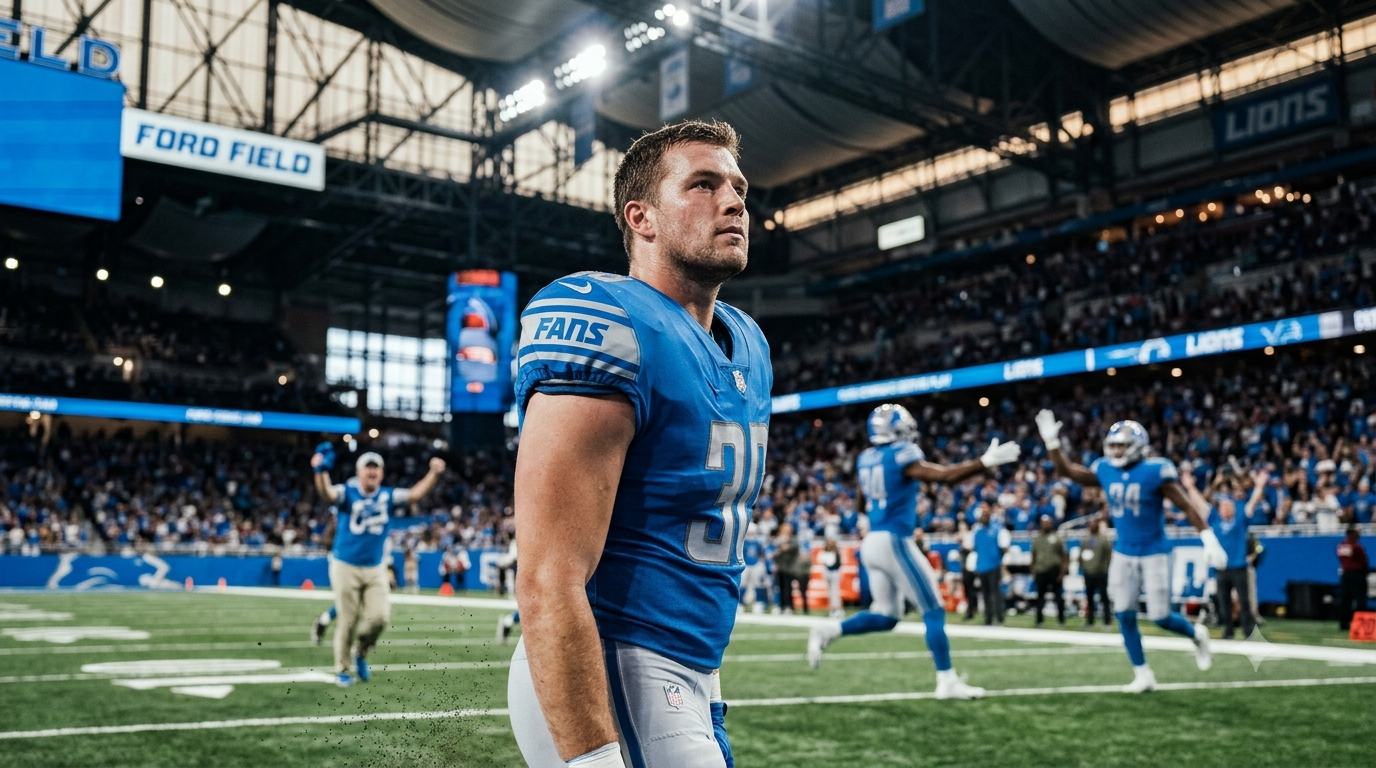
The Lions’ Defense Might Finally Have the Missing Piece It Needed
Every training camp has one play that immediately grabs headlines.
A spectacular catch.
A long touchdown.
A rookie making an impossible interception.
This year, one of those moments belonged to Derrick Barnes.
The veteran linebacker stepped in front of a Jared Goff pass for an interception during Day 2 of Detroit Lions training camp, giving fans and reporters one of the day’s biggest highlights. It was the type of play that quickly spreads across social media and dominates practice recaps.
But the interception itself wasn’t the most important story.
What happened before—and what it suggests about Barnes’ evolving role—may matter far more for the Lions’ 2026 season.
Because if Detroit’s defense takes another step this year, it may not be because of a blockbuster acquisition or a breakout rookie.
It may be because Derrick Barnes is finally becoming the player this coaching staff has envisioned all along.
Looking Beyond the Highlight
Training camp is full of splash plays that disappear once the regular season begins.
One practice doesn’t make a Pro Bowler.
One interception doesn’t suddenly transform a defense.
The Lions know that.
Dan Campbell and defensive coordinator Kelvin Sheppard aren’t evaluating who won a single rep. They’re evaluating consistency, communication, versatility, and trust.
That’s why Barnes’ interception is interesting—but his expanding role is even more important.
Throughout camp, coaches have continued to give Barnes opportunities to do more than simply attack downhill against the run. He’s being asked to cover more space, recognize route concepts, and remain on the field in situations where linebackers have traditionally been substituted out.
That evolution changes the conversation.
Instead of asking whether Barnes can make a big play, the better question becomes:
Can he become the complete linebacker Detroit’s defense has been missing?
The Modern NFL Demands More From Linebackers
The days of one-dimensional linebackers are fading quickly.
Offenses force defenders to cover elite tight ends, explosive running backs, mobile quarterbacks, and wide receivers attacking the middle of the field.
If a linebacker can’t stay on the field for all three downs, offenses know exactly how to attack him.
Detroit understands this better than most.
Every playoff-caliber offense the Lions expect to face can create mismatches against predictable defenses.
That means versatility has become almost as valuable as raw athleticism.
A linebacker who can defend the run, drop into coverage, disguise blitzes, and communicate adjustments before the snap gives the coaching staff far more freedom to build creative game plans.
Those players don’t always produce the biggest statistics.
But they often become the glue holding a defense together.
Barnes appears to be working toward becoming exactly that type of player.
This Isn’t an Overnight Success Story
It’s easy to forget that player development rarely follows a straight line.
Fans often expect immediate stars.
The Lions have consistently taken a different approach.
Brad Holmes has repeatedly invested in players he believes can grow within Detroit’s culture instead of chasing quick fixes every offseason.
We’ve seen that philosophy at multiple positions.
Read More:
Why the Lions Keep Choosing Trust Over Star Power
The organization has trusted coaching, repetition, and competition.
Barnes is another example of that long-term investment.
Instead of asking him to become everything immediately, the coaching staff has gradually expanded his responsibilities as his confidence and understanding have grown.
Training camp is beginning to reveal what those years of development may have produced.
A Defense Built on Flexibility
One of the biggest changes under Kelvin Sheppard’s leadership is the emphasis on adaptable defenders.
NFL offenses rarely present the same look twice.
Personnel changes.
Motion changes.
Tempo changes.
Defenses that require constant substitutions often give quarterbacks valuable information before the ball is even snapped.
The Lions want defenders capable of doing multiple jobs.
If Barnes continues earning trust in coverage while remaining effective against the run, Detroit gains flexibility that extends well beyond one position.
Suddenly, disguising blitzes becomes easier.
Changing coverages becomes smoother.
Rotating safeties becomes less predictable.
Pressure packages become more difficult for opposing quarterbacks to identify.
Those advantages rarely show up in fantasy football statistics.
They absolutely show up in January.
Why This Matters More Than a Single Interception
The easiest story to write after Day 2 is simple:
“Derrick Barnes intercepted Jared Goff.”
That’s accurate.
It’s also incomplete.
Interceptions happen every training camp.
Quarterbacks experiment.
Receivers make mistakes.
Defenders occasionally win the rep.
The more meaningful takeaway is that Barnes continues appearing in situations where those opportunities exist in the first place.
He’s being trusted with responsibilities that require awareness, communication, and coverage ability—not just physicality.
That trust isn’t built in one afternoon.
It’s earned over months of meetings, walkthroughs, practice repetitions, and film study.
That’s the development the Lions are really evaluating.
Detroit’s Defensive Ceiling May Depend on Players Like Barnes
Every contender needs stars.
Detroit has plenty of them.
Aidan Hutchinson changes games.
Brian Branch impacts multiple positions.
Kerby Joseph continues developing into one of the NFL’s most instinctive safeties.
But championship defenses aren’t built only around stars.
They’re built around reliable players who eliminate weak spots.
That’s where Barnes becomes especially interesting.
If he can consistently execute an expanded role, Detroit doesn’t just gain another productive linebacker.
The Lions become more difficult to predict.
And in today’s NFL, unpredictability is often one of the most valuable weapons a defense can possess.
This Is Exactly How Brad Holmes Wanted the Roster to Grow
When Brad Holmes took over the Lions, he wasn’t simply trying to assemble talented players.
He was trying to build a sustainable football team.
That distinction matters.
Talented rosters can have one great season.
Sustainable rosters compete year after year because they consistently develop players from within.
The Lions have repeatedly shown they believe coaching and development are competitive advantages.
Instead of replacing players at the first sign of inconsistency, Detroit has often doubled down on teaching, competition, and patience.
Barnes is one of the clearest examples of that philosophy.
There were moments early in his career when it would have been easy to label him as a rotational linebacker.
Instead, the Lions kept investing in his growth.
Now those investments may finally be paying off.
It’s a reminder that development isn’t always linear. Sometimes the biggest leap comes after years of steady progress rather than one spectacular offseason.
The Best Defenses Don’t Depend on One Superstar
Every fan loves a dominant pass rusher or a shutdown corner.
Those players deserve the attention they receive.
But the NFL’s best defenses usually share another characteristic.
They have very few weak links.
When an offense looks across the field, there isn’t an obvious player to attack over and over again.
That’s what Detroit is trying to build.
If Barnes becomes a dependable three-down linebacker, opposing offenses lose another potential mismatch.
Suddenly, offensive coordinators have fewer places to isolate a defender.
That makes everyone around him better.
A stronger linebacker corps helps the defensive line by creating hesitation in the run game.
It helps the secondary by improving coverage underneath.
It allows the coaching staff to disguise pressure packages more effectively.
Football is the ultimate interconnected sport.
One player’s development can elevate an entire unit.
Day 2 Offered Another Encouraging Sign
Barnes wasn’t the only positive takeaway from Day 2.
Multiple reports noted that Detroit’s passing offense looked sharper during seven-on-seven work after an uneven start to camp.
That’s exactly what you’d expect from a healthy training camp.
Some days the defense wins.
Other days the offense responds.
Those back-and-forth battles are often more valuable than one side dominating every practice.
The Lions aren’t trying to prove who has the better unit in July.
They’re trying to sharpen both units before the games begin to count.
The temporary absence of Jahmyr Gibbs also created additional opportunities for Detroit’s backup running backs to receive meaningful reps.
While fans naturally want to see their stars on the field, training camp is designed for moments like these.
Extra repetitions allow coaches to evaluate depth, identify unexpected contributors, and prepare for the inevitable challenges of a long NFL season.
That’s another reminder that every practice has multiple storylines.
The highlight may grab attention.
The development happening behind the scenes often has the bigger impact.
Training Camp Is About Building Answers
Fans often treat training camp like a scoreboard.
Who won today?
Who lost today?
Who made the highlight reel?
Inside Allen Park, the questions are very different.
Who earned more trust?
Who handled new responsibilities?
Who communicated effectively?
Who proved they deserve another opportunity?
Those are the answers that shape the final 53-man roster.
That’s why Barnes’ expanding role deserves attention.
It’s evidence that the coaching staff believes he’s ready for more responsibility—not simply because of one interception, but because of everything that led to it.
We’ve seen this pattern before.
Read More:
Dan Campbell Just Told Us What the Rest of the Lions Offseason Is About
Detroit has consistently rewarded preparation.
The players who embrace development tend to earn larger roles over time.
Barnes appears to be following that same path.
The Bigger Picture
As training camp continues, there will be bigger headlines.
There will be roster moves.
Injuries.
Breakout performances.
Perhaps even surprise additions from outside the organization.
Those stories matter.
But they shouldn’t distract from something equally important.
The Lions don’t need every improvement to come from outside the building.
In fact, championship organizations rarely operate that way.
Their greatest gains often come from players who were already on the roster taking the next step.
If Derrick Barnes is becoming that player for Detroit’s defense, the Lions may have solved one of their biggest questions without making a single transaction.
That’s a far more meaningful development than one memorable practice interception.
Final Thoughts
The highlight from Day 2 will be easy to remember.
Derrick Barnes stepping in front of a Jared Goff pass.
It’s the kind of clip that gets replayed across television and social media.
But months from now, that interception probably won’t matter.
What will matter is whether it represented something bigger.
Whether it was another sign that Barnes is evolving into a linebacker capable of staying on the field in every situation.
Whether Detroit’s commitment to patience and player development is producing another homegrown success story.
Whether the Lions have quietly strengthened their defense without the rest of the NFL fully noticing.
Training camp isn’t about crowning champions.
It’s about discovering what your team is becoming.
After two days in Allen Park, one possibility is becoming increasingly difficult to ignore.
The Lions may already have the missing piece they were searching for—and he was on the roster all along.
What Do You Think?
Has Derrick Barnes shown enough to earn a larger role in the Lions’ defense this season?
Or do you think Detroit still needs to add help before Week 1?
Share your thoughts in the comments below. We’d love to hear how you see the Lions’ defense taking shape as training camp continues.