Detroit Lions Defensive Identity: How Detroit Is Building a Defense That Survives January
Detroit’s Defense Was Never Meant to Win Headlines
Defenses that dominate highlight reels usually rely on chaos.
Blitz-heavy schemes.
Turnover spikes.
Flashy sack totals.
Those defenses often look unstoppable for stretches.
Until January.
Because playoff football exposes something subtle about defensive success: chaos rarely survives disciplined offenses.
The Detroit Lions appear to understand this reality.
Rather than chasing highlight statistics, Detroit’s front office is quietly building a defense designed to withstand the slow tightening of playoff football — the moment when every mistake becomes magnified.
This is not a defense designed for September dominance.
It is a defense designed to survive January football.
And that distinction explains many of the roster decisions Brad Holmes and Dan Campbell have made in recent seasons.
The Core Principle: Collapse Control
Most defenses focus on eliminating mistakes.
Great defenses understand that eliminating mistakes entirely is impossible.
Instead, they control the consequences of those mistakes.
Detroit’s defensive philosophy centers on something coaches rarely describe publicly:
Collapse control.
Collapse control means when something breaks — a missed tackle, a blown coverage, a delayed pass rush — the defense still compresses the play before it becomes catastrophic.
This requires a very specific combination of traits:
Speed to recover
Discipline in assignment
Communication across levels
The Lions are gradually assembling players who embody those traits.
Why the Pass Rush Is the Engine of the Defense
Every modern defense begins with the same question:
Can we disrupt the quarterback before the play develops?
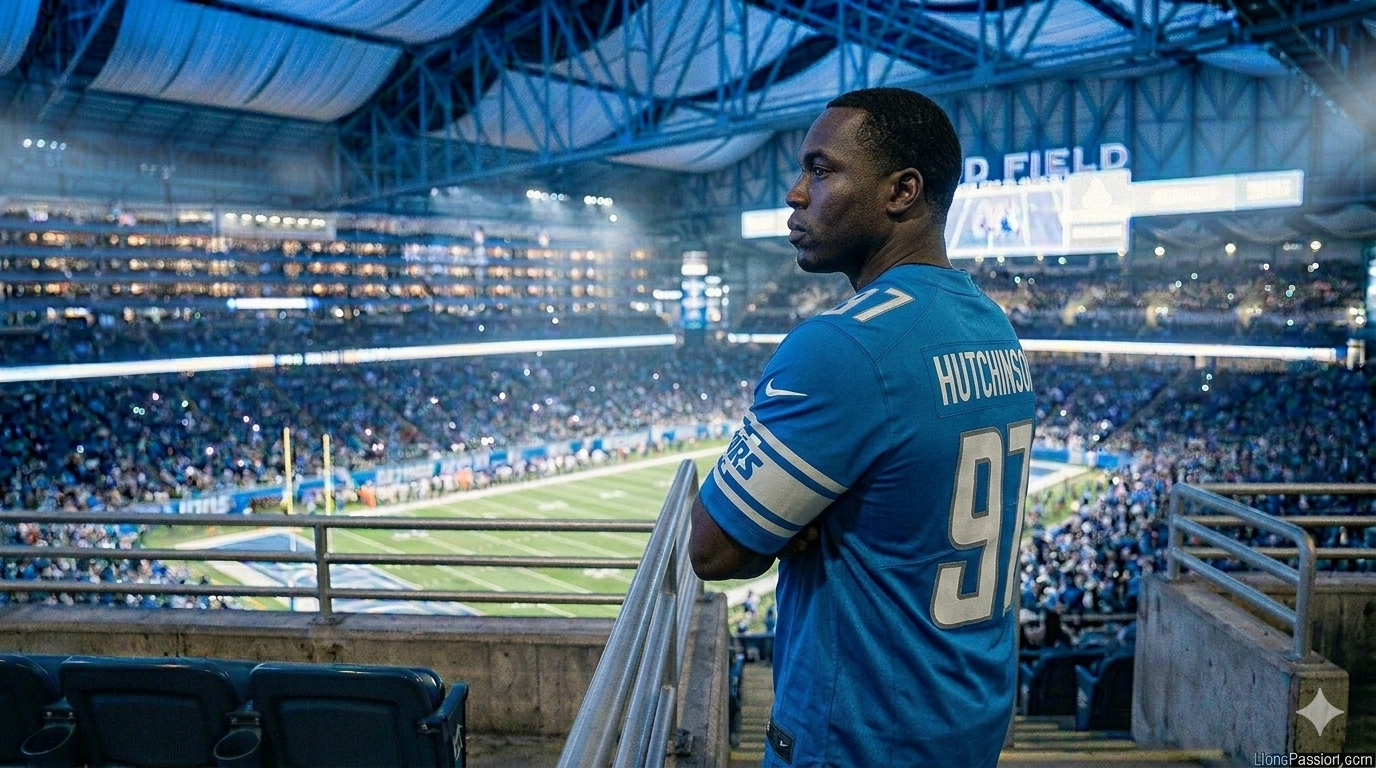
For Detroit, the answer begins with Aidan Hutchinson.
Hutchinson represents more than a productive pass rusher. He represents the emotional and structural center of the defense.
Elite pass rushers influence every other defensive position.
They shorten the time quarterbacks have to read coverage.
They force quicker throws.
They create rushed decisions that secondary players can exploit.
Detroit’s defensive investments frequently revolve around amplifying Hutchinson’s impact.
Rather than relying on constant blitzing, the Lions prefer generating pressure through the front four. This allows the secondary to maintain coverage integrity while still forcing quarterbacks into uncomfortable situations. Detroit’s roster construction philosophy
Why Defensive Line Depth Matters More Than Star Power
One of the most overlooked elements of defensive success is rotational depth.
Elite pass rushers can dominate stretches of games, but sustaining that dominance over a full season requires support.
Detroit’s defensive line philosophy emphasizes constant rotation.
Fresh pass rushers maintain pressure late in games.
Interior defenders collapse pockets even when edge rushers are contained.
Opposing offensive lines struggle to maintain rhythm against shifting fronts.
Rather than building around a single superstar, Detroit appears committed to constructing a defensive line capable of maintaining disruption across sixty minutes.
Speed on Defense Isn’t About Highlights
Fans often hear analysts talk about “speed on defense.”
The phrase usually conjures images of defenders chasing down ball carriers across open field.
But the Lions’ emphasis on defensive speed serves a different purpose.
Speed provides recovery margin.
When defensive leverage breaks down, speed allows defenders to regain positioning before the play becomes explosive.
Cornerbacks recover when receivers gain early separation.
Linebackers close rushing lanes that briefly open.
Safeties erase coverage mistakes.
This recovery margin becomes critical in playoff environments where offenses exploit every structural weakness. Detroit’s disciplined draft strategy
Detroit’s focus on speed reflects its commitment to reducing those weaknesses.
The Secondary’s Role in Defensive Stability
While pass rush initiates pressure, coverage determines whether that pressure becomes meaningful.
Detroit’s secondary has gradually evolved into a unit designed to maintain discipline under stress.
Rather than gambling for interceptions constantly, the Lions emphasize positional integrity.
Defenders remain patient in coverage.
They communicate across zones.
They avoid surrendering easy explosive plays.
This style of defense may not produce dramatic turnover numbers every week, but it forces oppoLinebackers as the System Connectors
Linebackers often operate as the bridge between the defensive line and the secondary.
In Detroit’s defensive structure, that role becomes even more important.
Linebackers must read run concepts quickly while maintaining awareness of intermediate passing routes.
They must communicate adjustments when offenses shift formations.
They must close space when coverage briefly breaks down.
Players who thrive in this role combine physical speed with mental processing ability.
The Lions’ scouting philosophy increasingly emphasizes those traits.
Defensive Culture Mirrors Offensive Culture
Just as the offense emphasizes discipline and physical structure, the defense reflects a similar mentality.
Detroit defenders are expected to play with controlled aggression.
Aggressive enough to disrupt plays.
Disciplined enough to maintain assignment integrity.
This balance prevents the defense from becoming overly reactive.
Instead of chasing every play, Detroit’s defenders focus on compressing space and forcing offenses to execute perfectly over extended drives.
how the Lions build their offense
Few offenses sustain that level of precision consistently.
The Long-Term Goal: January Survivability
The Lions’ defensive philosophy ultimately points toward one goal.
January football.
Playoff games tighten margins dramatically.
Explosive plays become rarer.
Field position matters more.
Mistakes become decisive.
Defenses that rely on volatility often collapse in those environments.
Detroit’s approach attempts to avoid that vulnerability.
By prioritizing pass rush pressure, coverage discipline, and recovery speed, the Lions are constructing a defense capable of surviving the moments when playoff games slow down and become brutally precise.
Why Detroit’s Defensive Evolution Is Still Ongoing
Despite clear progress, the Lions’ defensive identity is still evolving.
The roster will continue adjusting as new draft classes arrive and veteran players transition through the system.
Brad Holmes’ defensive acquisitions often reflect long-term thinking rather than immediate results.
Players may require development before fully contributing.
New schemes may take time to stabilize.
Depth pieces may not become visible until injuries test the roster.
This patience mirrors the broader philosophy guiding Detroit’s roster construction.
The Lions are not building a defense for a single season.
They are building one that can endure.
Final Thought
Great defenses are rarely defined by individual stars alone.
They are defined by systems.
Systems that emphasize discipline.
Systems that recover when mistakes occur.
Systems that compress chaos rather than amplify it.
Detroit’s defense is gradually becoming one of those systems.
And if the Lions continue reinforcing that structure through disciplined drafting and thoughtful roster management, the defense may become the element that ultimately pushes Detroit from contender to champion.
If you want to understand how the Detroit Lions are truly building their roster — beyond headlines and rumors — explore the full LionsPassion analysis hub.
Start with these cornerstone breakdowns:
How Brad Holmes Is Building the Detroit Lions
Detroit Lions Draft Philosophy
Detroit Lions Offensive Identity
Because understanding the structure behind the Lions’ rise reveals far more than simply watching the scoreboard.