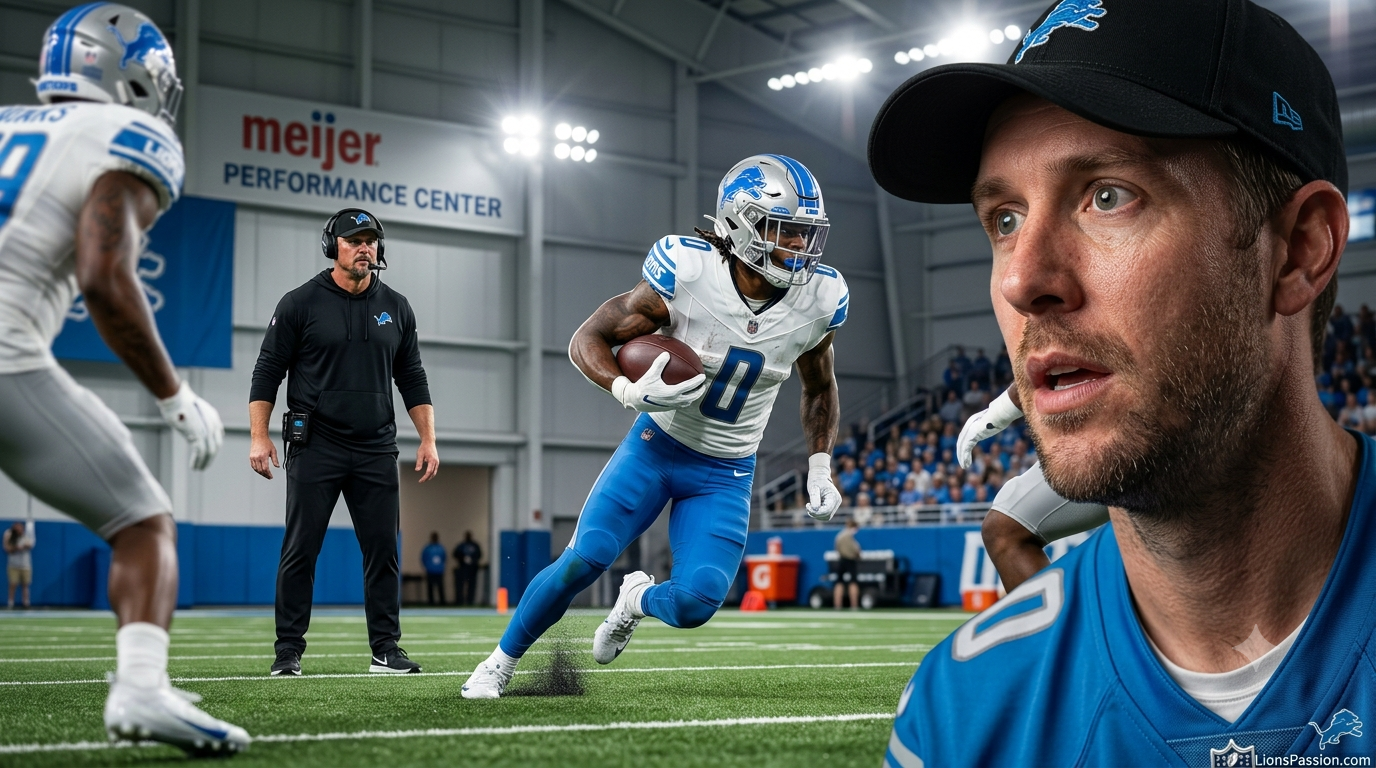
Dan Campbell Just Confirmed What Makes Jahmyr Gibbs Different
Dan Campbell Just Confirmed What Makes Jahmyr Gibbs Different
There are plenty of talented running backs in the NFL.
There are fewer game changers.
And then there are the players who force defensive coordinators to throw part of their game plan in the trash before the opening kickoff.
Dan Campbell may have quietly told us which category Jahmyr Gibbs belongs in.
When Campbell spoke about Gibbs returning to the field after missing time early in training camp, he didn’t simply say the Lions were getting one of their best offensive players back.
He called him a “weapon.”
That word matters.
NFL coaches choose their language carefully.
Especially veterans like Campbell.
A running back runs the football.
A receiver catches passes.
A tight end controls the middle of the field.
A weapon?
A weapon changes everything.
The difference isn’t just semantics.
It’s philosophy.
And if Campbell’s comments are any indication, the Detroit Lions are preparing to use Jahmyr Gibbs in ways that go far beyond the traditional expectations of an NFL running back.
The Best Players Change Defensive Math
Football is often described as a game of matchups.
That’s true.
But it’s also a game of mathematics.
Every defensive coordinator begins with one basic question:
Where do we have to dedicate extra resources?
Against some teams, the answer is an elite wide receiver.
Against others, it’s a dominant pass rusher.
Against Detroit, that answer is becoming increasingly complicated.
Because Gibbs isn’t simply dangerous when he lines up in the backfield.
He’s dangerous before the ball is even snapped.
Motion him outside.
The defense has to communicate.
Line him up in the slot.
A linebacker suddenly becomes uncomfortable.
Split him wide.
Now a cornerback may have to leave another assignment.
Every adjustment creates another opportunity somewhere else.
That’s what Campbell means when he calls Gibbs a weapon.
He’s talking about the stress one player places on an entire defensive structure.
Why “Weapon” Is Different Than “Star”
Fans often use words like elite, explosive, or dynamic.
Those descriptions fit Gibbs.
But Campbell chose something different.
Weapons aren’t defined by statistics.
They’re defined by consequences.
Defenses don’t fear a weapon because of what he did last week.
They fear what he could do on the very next snap.
That’s a meaningful distinction.
Some running backs become dangerous after they receive the football.
Gibbs becomes dangerous the moment he walks into the huddle.
His presence changes personnel packages.
It changes coverage calls.
It changes blitz decisions.
It changes how linebackers align before the snap.
And sometimes, those changes are exactly what offensive coordinators are hoping to create.
The ball doesn’t even have to go to Gibbs for him to influence the play.
That’s what separates great players from offensive weapons.
Detroit’s Offense Was Built Around Multipliers
One thing Brad Holmes and Dan Campbell have consistently pursued is versatility.
Not versatility for its own sake.
Versatility that multiplies options.
Look across Detroit’s offensive roster.
Sam LaPorta isn’t simply a tight end.
He’s a matchup problem.
Amon-Ra St. Brown isn’t simply a possession receiver.
He can line up almost anywhere.
Penei Sewell doesn’t just block.
He changes how Detroit can run its offense.
Now consider Gibbs.
He’s not merely replacing carries that another running back would receive.
He’s creating offensive possibilities that wouldn’t exist without him.
That’s an important difference.
The Lions aren’t building around positions.
They’re building around problems.
Every player who can force a defense to hesitate creates opportunities for everyone else.
We’ve written before about Detroit’s commitment to developing players who fit that larger vision rather than chasing short-term headlines.
Read More:
Why the Lions Keep Choosing Trust Over Star Power
Gibbs may be the clearest example of that philosophy paying off.
His Return Changes More Than the Running Game
The encouraging news surrounding Sam LaPorta’s health at the start of training camp already suggested Detroit’s offensive core was coming together at the right time.
Now Gibbs’ return strengthens that picture even further.
It’s tempting to measure this only in rushing attempts.
How many carries?
How many yards?
How many touchdowns?
Those numbers matter.
But they don’t tell the whole story.
When Gibbs is available, Detroit doesn’t simply gain another offensive player.
The Lions regain flexibility.
They regain unpredictability.
They regain one of the few players capable of forcing defensive coordinators to rethink their game plan before the opening drive.
That’s difficult to quantify.
It’s impossible to ignore.
Day Two Quietly Reinforced the Point
While Gibbs returned, another storyline unfolded alongside him.
Detroit’s passing offense appeared noticeably sharper during seven-on-seven work.
Teddy Bridgewater delivered several impressive throws.
The timing between quarterbacks and receivers looked cleaner.
The offense began finding its rhythm after an uneven opening day.
Some fans will naturally connect those developments only to quarterback play.
But offensive rhythm rarely belongs to one position.
It comes from confidence.
Continuity.
Timing.
The return of elite playmakers helps create all three.
Every offense functions more efficiently when its most dangerous players are available.
And every quarterback becomes more comfortable knowing the player coaches describe as a “weapon” is back on the field.
The NFL Is Moving Toward Positionless Football
Watch enough football, and you begin to notice something.
The league is becoming harder to define by traditional positions.
Wide receivers line up in the backfield.
Running backs split out wide.
Tight ends become slot receivers.
Quarterbacks are expected to create outside the structure of the play.
The best offenses don’t ask one simple question anymore:
“What position does this player play?”
They ask something much more difficult for defenses to answer:
“Who can stop this player?”
That’s where Jahmyr Gibbs becomes such a unique challenge.
Labeling him a running back doesn’t actually explain what he does.
He’s a mismatch creator.
A spacing creator.
A defensive stress test.
Every snap forces defenders to make decisions before the football is even in the air.
And in today’s NFL, hesitation is often all an offense needs.
Why Defenses Hate Preparing for Players Like Gibbs
One of the most difficult jobs in football belongs to defensive coordinators.
Their job isn’t simply stopping great players.
It’s eliminating uncertainty.
Against Detroit, uncertainty often begins with No. 26.
Imagine spending an entire week preparing to stop Detroit’s rushing attack.
Then Gibbs motions into the slot.
Now your linebacker has to decide whether to follow him.
If he does, Jared Goff immediately knows where the coverage is likely headed.
If he doesn’t, the defense risks putting a slower defender in space against one of the league’s quickest athletes.
That’s not an accident.
That’s design.
Campbell wasn’t exaggerating when he called Gibbs a weapon.
He was describing a player whose greatest impact often comes before the ball is snapped.
Some offensive players create production.
Others create opportunities.
Gibbs consistently creates both.
Great Offenses Depend on Interconnected Stars
Football fans naturally separate players into individual conversations.
Jared Goff’s season.
Sam LaPorta’s season.
Amon-Ra St. Brown’s season.
Jahmyr Gibbs’ season.
The Lions don’t think that way.
Neither should we.
Everything Detroit does offensively is connected.
A healthy LaPorta changes how defenses handle the middle of the field.
Amon-Ra forces attention underneath.
Jameson Williams stretches defenses vertically.
Penei Sewell gives the offense confidence to remain aggressive.
And Gibbs ties those pieces together because he can threaten defenses from virtually anywhere.
That’s why his return matters so much.
Not because one player fixes every problem.
Because one player can make every other player more dangerous.
We’ve talked repeatedly this offseason about how Detroit values versatility over specialization.
Read More:
Dan Campbell Just Told Us What the Rest of the Lions Offseason Is About
Gibbs may be the ultimate example of that philosophy.
He’s not confined by one job description.
He’s defined by the problems he creates.
Why Fantasy Football Doesn’t Tell the Whole Story
Over the next several weeks, fantasy football analysts will debate where Gibbs should be selected.
Some will rank him among the top running backs.
Others will argue his receiving ability increases his value in PPR formats.
Those conversations are fun.
They’re also incomplete.
Fantasy football measures touches.
The NFL measures impact.
There will be games where Gibbs doesn’t produce eye-popping statistics but still changes the outcome.
Why?
Because defenses dedicate resources to him.
Because safeties hesitate.
Because linebackers widen their alignment.
Because corners communicate differently before the snap.
Those effects don’t appear in fantasy box scores.
They absolutely appear on coaching film.
Campbell understands that.
That’s another reason the word “weapon” fits so well.
Detroit’s Offensive Ceiling Just Became Clearer
Training camp is often about answering questions.
Can the offensive line stay healthy?
Who wins the depth battles?
Which young players are ready for larger roles?
For the Lions, another important question quietly lingered after the opening practices.
Would the offense regain its full rhythm once its stars returned?
Early signs are encouraging.
LaPorta’s positive health update removed one concern.
The passing game looked noticeably sharper during Day 2.
Bridgewater showed the value of having an experienced veteran in the quarterback room.
Receivers began finding their timing.
Now Gibbs is back.
Individually, those developments are encouraging.
Collectively, they suggest something bigger.
Detroit’s offensive identity is beginning to take shape again.
And that’s exactly what championship contenders hope to see before August turns into September.
Why This Matters in January, Not July
The easiest mistake fans make during training camp is believing every story is about Week 1.
Campbell rarely thinks that way.
Neither does Brad Holmes.
Everything happening in Allen Park is building toward something much larger.
The goal isn’t winning the first practice.
It’s building an offense capable of surviving four months of adjustments, injuries, adversity, and playoff football.
That’s where players like Gibbs become invaluable.
Explosive athletes are always important.
Players who force defenses to redesign game plans become essential.
There are only a handful of those players in the NFL.
Detroit believes Gibbs is one of them.
Campbell’s comments strongly suggest he agrees.
Final Thoughts
Every offseason produces exciting headlines.
A spectacular catch.
An impressive throw.
An interception.
A breakout rookie.
Those moments matter.
But sometimes the biggest takeaway comes from something much simpler.
One word.
Weapon.
Dan Campbell could have described Jahmyr Gibbs in dozens of different ways.
Fast.
Dynamic.
Explosive.
Elite.
Instead, he chose the word that best captures how the Lions truly view him.
Not simply as one of their best players.
But as someone capable of changing the entire structure of a defense.
That’s a rare compliment.
It’s an even rarer responsibility.
If the first few days of training camp are any indication, Detroit is preparing to place that responsibility squarely on Gibbs’ shoulders.
And if he continues developing into the complete offensive weapon Campbell believes he is, the Lions won’t just have one of the NFL’s best running backs.
They’ll have one of the league’s most difficult players to defend.
That’s the kind of player championship offenses are built around.
What Do You Think?
Do you think Jahmyr Gibbs is already the most dangerous offensive weapon on the Lions’ roster, or does another player deserve that title?
Share your thoughts in the comments below. We’d love to hear how you think Detroit should use Gibbs as training camp continues.