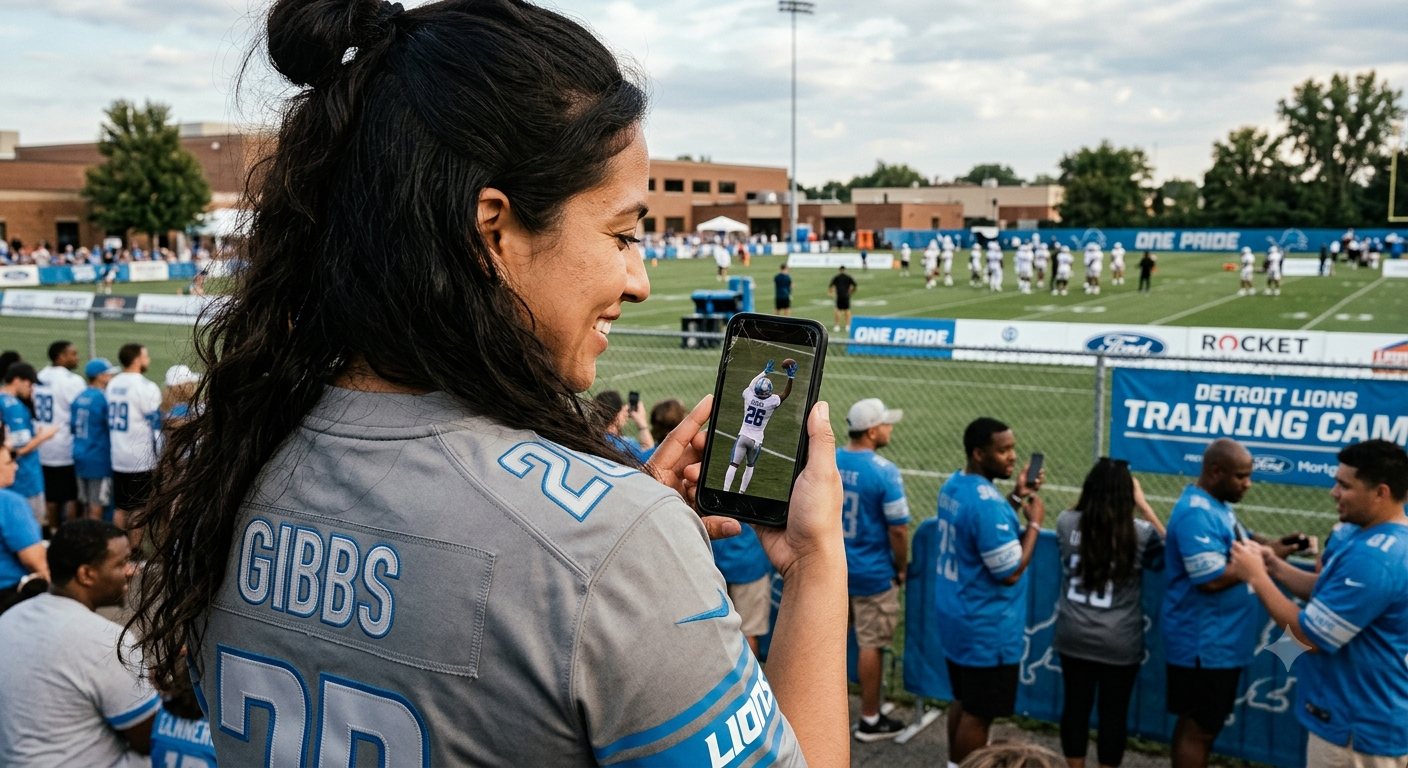
The Jahmyr Gibbs Contract Situation Isn’t Really About Money
The Jahmyr Gibbs Contract Situation Isn’t Really About Money
Every NFL contract negotiation eventually reaches the same point.
Fans start counting dollars.
How much is the player worth?
Who’s resetting the market?
Which contract becomes the comparison?
This week, much of that conversation shifted toward Detroit after Atlanta rewarded Bijan Robinson with a massive extension. Almost immediately, attention turned to Jahmyr Gibbs.
Would Robinson’s deal speed up negotiations?
Would it make Gibbs more expensive?
Would the Lions now feel pressured to move quickly?
Dan Campbell didn’t sound worried.
In fact, he suggested the opposite.
Campbell expressed hope that Robinson’s extension could actually help move discussions forward rather than complicate them.
That response reveals something important.
The Lions don’t appear to view this negotiation as a race against the market.
They view it as another step in a much larger process.
And if Brad Holmes’ track record tells us anything, it’s that timing has always mattered just as much as money.
The Public Sees Contracts. Front Offices See Windows.
One of the easiest mistakes fans make is assuming every contract negotiation begins with a dollar figure.
Front offices usually start somewhere else.
Timing.
Salary-cap projections.
Future extensions.
Roster flexibility.
A contract doesn’t exist by itself.
Every extension affects another decision waiting around the corner.
That’s especially true for championship contenders.
The Lions aren’t trying to build the best roster for one season.
They’re trying to keep one of the NFL’s strongest cores together for several years.
That changes how negotiations unfold.
Every agreement has to fit within a broader financial plan.
Brad Holmes Has Been Remarkably Consistent
Look back at how Holmes has managed the roster since arriving in Detroit.
Rarely has he appeared rushed.
Rarely has he negotiated through the media.
Rarely has he reacted emotionally to outside pressure.
Instead, Holmes has followed a predictable pattern.
Identify cornerstone players.
Develop them.
Reward them when the timing aligns with the organization’s long-term vision.
That philosophy has helped transform Detroit from a rebuilding franchise into one of the NFL’s healthiest organizations.
We’ve written before about why Holmes consistently values patience over impulse.
Brad Holmes has quietly followed the same roster-building philosophy since arriving in Detroit.
The Gibbs situation appears to fit that same blueprint.
Why Bijan Robinson’s Deal Matters
It’s tempting to view Robinson’s extension as a problem for Detroit.
Robinson’s extension creates more clarity than panic.
It’s another example of why Detroit values patience over reacting to the latest headlines.
After all, every major running back contract influences the next negotiation.
That’s simply how the NFL works.
But precedent isn’t necessarily pressure.
It creates information.
The market becomes clearer.
Comparable contracts become easier to evaluate.
Both sides gain a stronger understanding of where discussions are likely to begin.
That’s one reason Campbell sounded optimistic instead of concerned.
A completed deal often removes uncertainty.
And uncertainty is usually the biggest obstacle in any negotiation.
This Is Bigger Than One Running Back
Jahmyr Gibbs is one of the most dynamic offensive players in football.
His importance to Detroit is obvious.
But Holmes can’t negotiate as though Gibbs is the only player who matters.
Extensions for cornerstone players require balancing today’s priorities against tomorrow’s realities.
Who becomes eligible next?
Which contracts expire in two years?
How much cap flexibility should remain available?
Those aren’t exciting questions.
They’re championship questions.
The organizations that answer them well stay competitive for years.
The ones that don’t often discover too late that keeping a talented roster together is much harder than assembling it in the first place.
Why the Lions Aren’t Negotiating From Panic
Perhaps the most encouraging aspect of Campbell’s comments is what they didn’t reveal.
There was no urgency.
No frustration.
No public pressure.
That calmness reflects confidence.
Detroit knows what Gibbs means to its offense.
Gibbs knows what Detroit has built around him.
Both sides have reasons to reach an agreement.
That’s a much healthier starting point than many NFL negotiations ever enjoy.
Instead of creating conflict, Campbell’s comments suggested the organization believes the process is unfolding naturally.
That doesn’t guarantee a quick resolution.
It does suggest the Lions aren’t allowing outside headlines to dictate internal decisions.
Elite Organizations Don’t Negotiate Emotionally
One of the clearest differences between stable franchises and struggling ones is how they handle moments like this.
Organizations under pressure often negotiate with emotion.
They react to headlines.
They respond to public criticism.
They allow outside narratives to speed up internal decisions.
The Lions have shown very little interest in operating that way.
Brad Holmes has spent the past several seasons building one of the NFL’s deepest and youngest core rosters.
That work wasn’t done to create a single championship opportunity.
It was done to create multiple opportunities.
Protecting that window requires discipline.
Every extension has to make sense not only today, but several seasons from now.
That’s why patience shouldn’t be mistaken for hesitation.
Sometimes the smartest negotiation is the one that refuses to become a public spectacle.
Jahmyr Gibbs Is More Than a Running Back
If this negotiation were only about rushing yards, the conversation would be much simpler.
Gibbs isn’t simply a running back.
He’s one of the most versatile offensive players in football.
He changes defensive personnel.
He forces linebackers into uncomfortable matchups.
He influences coverage before the ball is even snapped.
That versatility makes negotiations more complex.
How do you assign value to a player whose impact extends beyond one traditional position?
The answer isn’t found solely in statistics.
It’s found in how much harder he makes life for every defense Detroit faces.
The Championship Window Is Bigger Than One Contract
One temptation during negotiations is to treat each extension as its own isolated event.
The Lions can’t afford to think that way.
Every major contract becomes another piece of a much larger financial puzzle.
That strategy only works if future flexibility remains intact.
Today’s agreement can’t compromise tomorrow’s opportunities.
That’s one reason Holmes has consistently earned respect around the league.
He appears willing to make difficult financial decisions before they become necessary.
We’ve seen that same philosophy shape the roster in other ways.
Whether it’s strengthening linebacker depth before injuries become a crisis or emphasizing player development over splashy free-agent signings, Detroit has repeatedly shown a preference for preparation over reaction.
The Message Inside Campbell’s Comments
It’s easy to focus on what Campbell actually said.
The more revealing detail may be what he didn’t say.
He didn’t sound frustrated.
He didn’t suggest negotiations had stalled.
He didn’t imply the organization felt trapped by Robinson’s new contract.
Instead, he sounded like someone who understands how these situations typically unfold.
Markets evolve.
Comparable contracts are established.
Both sides gather information.
Then serious negotiations continue.
That’s a remarkably ordinary process.
And ordinary processes often produce stable outcomes.
The Lions don’t appear interested in winning the news cycle.
They’re interested in reaching an agreement both sides can feel confident about for years.
Why Fans Shouldn’t Fear the Waiting
Waiting is uncomfortable.
Especially when the player involved is one of the most exciting talents on the roster.
Silence often creates speculation.
Speculation creates anxiety.
Before long, routine negotiations begin feeling like organizational drama.
Most of the time, they aren’t.
Contract discussions between successful organizations and cornerstone players rarely move at the pace fans would prefer.
That doesn’t mean they’re moving in the wrong direction.
If anything, Detroit’s recent history suggests the opposite.
That patience has helped create one of the NFL’s strongest foundations.
There’s little evidence to believe he’ll abandon that approach now.
Final Thoughts
It’s easy to look at Jahmyr Gibbs’ contract situation and see a negotiation.
Brad Holmes likely sees something much larger.
He sees the future of an entire roster.
The future of a championship window.
The future of a salary cap designed to keep Detroit competitive long after this season ends.
That’s why the conversation shouldn’t begin or end with Bijan Robinson’s extension.
It should begin with understanding how the Lions have built one of the league’s most stable organizations.
Campbell’s comments reflected confidence.
Not urgency.
Holmes’ history reflects preparation.
Not reaction.
Together, those two qualities explain why this negotiation feels different from many of the high-profile contract battles we’ve seen across the NFL.
The Lions aren’t trying to win today’s headlines.
They’re trying to keep tomorrow’s roster together.
If that means taking a little more time before announcing an extension, history suggests Detroit is comfortable making that trade.
And based on everything Brad Holmes has accomplished since arriving in Allen Park, there are good reasons for fans to be patient too.
What Do You Think?
Should the Lions move quickly to extend Jahmyr Gibbs now that the running back market has been reset, or should Brad Holmes continue following the patient approach that has helped build Detroit into one of the NFL’s strongest contenders?
Share your thoughts in the comments below. We’d love to hear how you would balance rewarding one of the league’s most dynamic playmakers while protecting the team’s long-term championship window.