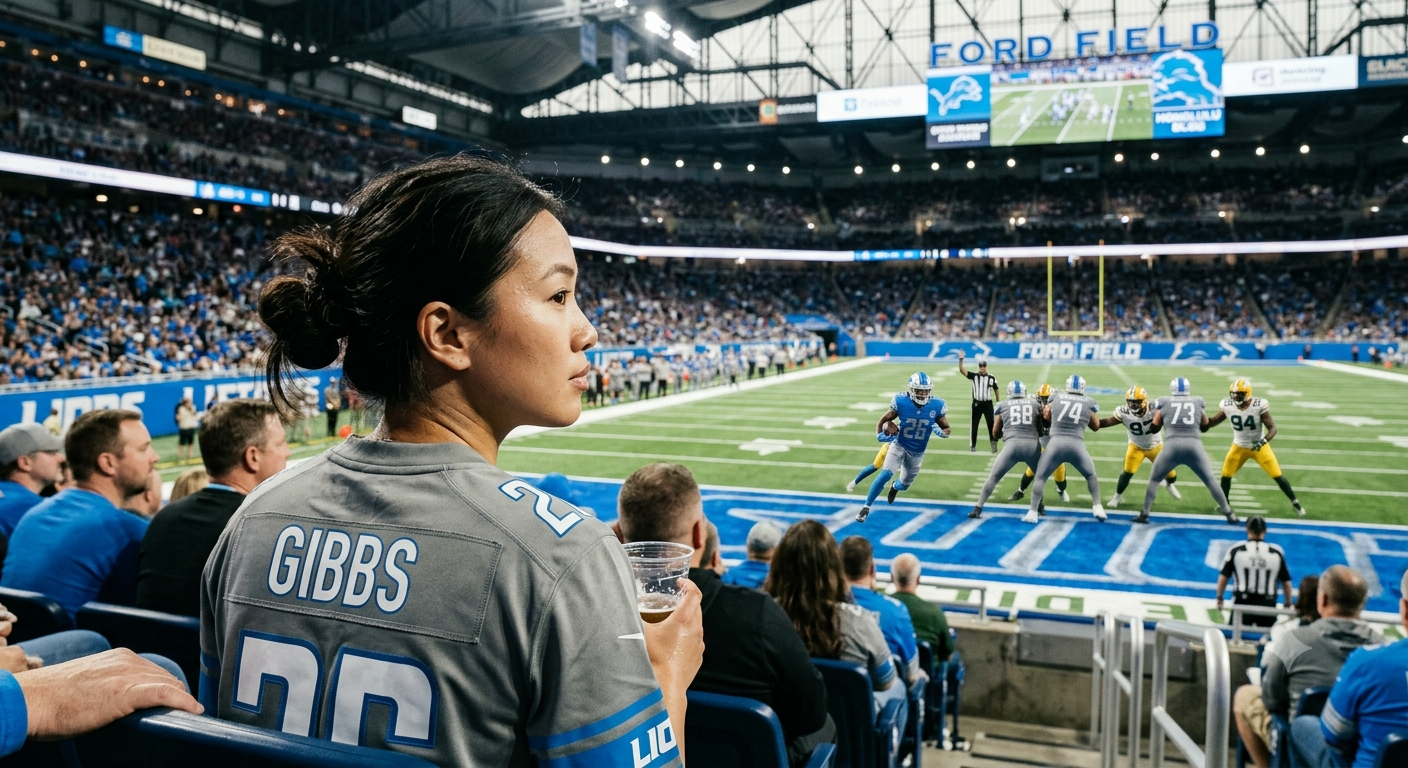
The Jahmyr Gibbs Hold-In Is Revealing Something Most Fans Are Missing
The Jahmyr Gibbs Hold-In Is Revealing Something Most Fans Are Missing
Sometimes the biggest story isn’t what people are saying.
It’s what they aren’t.
For the past several days, the conversation surrounding Jahmyr Gibbs has revolved around one topic.
His contract.
Bijan Robinson reset the running back market with a massive extension. Almost immediately, attention shifted to Detroit.
Would Jahmyr Gibbs be next?
Would negotiations speed up?
Would his “hold-in” become a distraction?
Outside the building, those questions have fueled endless speculation.
Inside the building, the tone has been remarkably different.
Dan Campbell hasn’t sounded frustrated.
Brad Holmes hasn’t shown any signs of panic.
Even Gibbs himself hasn’t appeared interested in escalating the situation.
That contrast may tell us more than any contract update ever could.
Because when an NFL organization stays this calm during a high-profile negotiation, it’s usually a sign that both sides understand exactly where things stand.
The Loudest Story Is Often the Wrong Story
NFL contract discussions tend to follow the same pattern.
A comparable player signs a new deal.
Fans assume the next contract has become dramatically more complicated.
Media outlets begin counting dollars.
Every public comment gets analyzed for hidden meaning.
Soon, ordinary negotiations begin looking like organizational conflict.
That’s where the Lions currently find themselves.
Yet very little suggests anyone inside Allen Park views this as a crisis.
Campbell recently acknowledged that he’s anxious to have Gibbs back on the practice field.
That’s exactly what you would expect from a head coach who relies on one of the league’s most dynamic offensive weapons.
What Campbell didn’t do was create pressure.
He didn’t criticize Gibbs.
He didn’t question the process.
He didn’t hint that negotiations had become contentious.
Those omissions matter.
Brad Holmes Has Never Negotiated Through Emotion
One of the defining characteristics of Brad Holmes’ tenure has been consistency.
Whether it’s the draft, free agency, trades, or contract extensions, Holmes rarely allows outside pressure to dictate internal decisions.
He’s shown that patience isn’t hesitation.
It’s part of the plan.
Since arriving in Detroit, Holmes has identified cornerstone players, invested in their development, and worked to keep the team’s competitive window open without sacrificing long-term flexibility.
That approach has helped transform the Lions from an organization searching for stability into one of the NFC’s most respected contenders.
We’ve seen this philosophy shape nearly every major roster decision.
Read More:
The Lions Have Reached the Moment Brad Holmes Has Been Preparing For
The Gibbs situation doesn’t feel like an exception.
It feels like another example.
A Hold-In Isn’t the Same Thing as a Holdout
One detail that’s often lost in the conversation is the difference between a hold-in and a holdout.
A holdout is designed to create leverage by staying away from the team.
A hold-in keeps the player inside the building.
He’s still attending meetings.
Still participating with teammates.
Still engaged in the daily rhythm of the organization, even if his on-field workload changes.
That’s a significant difference.
It keeps communication open.
It minimizes unnecessary tension.
Most importantly, it reinforces that both sides are still working toward the same outcome.
The Lions want Jahmyr Gibbs to remain a foundational piece of their offense.
Gibbs has repeatedly spoken about how much he enjoys playing in Detroit and what Campbell’s culture has meant to his development.
Those realities haven’t changed because another running back signed a larger contract.
Why Dan Campbell’s Comments Were More Important Than They Seemed
Campbell’s recent remarks about Bijan Robinson’s extension may have sounded ordinary.
They weren’t.
Rather than suggesting Robinson’s deal complicated Detroit’s negotiations, Campbell expressed hope that it could actually help move conversations forward.
That’s an important distinction.
It suggests the Lions see market clarity—not market inflation.
Once elite contracts establish a benchmark, both teams and agents have a clearer starting point for productive discussions.
The uncertainty begins to disappear.
That doesn’t guarantee an immediate agreement.
But it often creates a more realistic negotiating environment.
For an organization that values preparation over reaction, that’s exactly where it wants to be.
This Is About More Than One Player
Jahmyr Gibbs is unquestionably one of the most explosive players on Detroit’s roster.
His value extends far beyond traditional rushing statistics.
He changes defensive game plans.
He creates matchup problems for linebackers and safeties.
He forces opponents to defend every inch of the field.
We’ve already explored why Dan Campbell’s description of Gibbs as a “weapon” wasn’t just coach-speak—it reflected how the Lions actually build their offense.
Read More:
Dan Campbell Just Confirmed What Makes Jahmyr Gibbs Different
That’s exactly why this negotiation deserves patience.
The Lions aren’t simply assigning a dollar amount to a running back.
They’re evaluating the long-term value of one of the most unique offensive players in the NFL while protecting the championship window they’ve spent years building.
And based on everything we’ve seen from Brad Holmes and Dan Campbell, that’s a process they have no intention of rushing.
Calm Is Often a Sign of Confidence
Professional sports have conditioned fans to believe that silence is a bad sign.
When there are no contract updates, people assume negotiations have stalled.
When a player gives a brief answer, it’s interpreted as frustration.
When a coach avoids dramatic statements, speculation fills the gap.
The Lions have consistently operated differently.
Brad Holmes and Dan Campbell have built one of the NFL’s most stable organizations by refusing to negotiate through public emotion.
That approach hasn’t changed because Jahmyr Gibbs is waiting for a new contract.
If anything, the calm surrounding this situation suggests both sides understand what’s at stake.
The Lions know Gibbs is a cornerstone player.
Gibbs knows he’s in one of the league’s most player-friendly environments.
Those realities create a foundation for productive negotiations instead of public conflict.
Protecting the Championship Window
It’s easy to view this as a negotiation between a team and one player.
Brad Holmes almost certainly sees something much bigger.
Every contract extension affects the next one.
Every major financial decision influences roster flexibility years into the future.
Detroit has spent the better part of five seasons assembling one of the youngest and deepest cores in football.
Keeping that group together requires discipline.
The Lions aren’t trying to maximize one season.
They’re trying to maximize several.
That philosophy has appeared repeatedly throughout Holmes’ tenure.
Whether it’s drafting and developing talent, resisting splashy free-agent signings, or strengthening depth before injuries become major problems, Detroit has consistently prioritized sustainability over short-term headlines.
We’ve explored that philosophy before.
Read More:
Why the Lions Keep Choosing Trust Over Star Power
The Gibbs negotiations fit naturally within that same blueprint.
The Hold-In Hasn’t Changed the Locker Room
One of the most encouraging signs during training camp is what hasn’t happened.
There has been no visible tension.
No public disagreement.
No teammates questioning Gibbs’ commitment.
No comments suggesting frustration inside the locker room.
That’s important because championship teams understand that contract negotiations are part of the NFL business.
Veteran players have experienced them before.
Young players understand they eventually will as well.
The difference lies in how organizations manage those moments.
Detroit appears to have created an environment where business decisions don’t automatically become distractions.
That stability reflects years of work by Campbell, Holmes, and the leadership inside the locker room.
Jahmyr Gibbs’ Value Goes Beyond Statistics
Trying to define Gibbs strictly through rushing yards misses the point entirely.
He isn’t simply a running back.
He’s one of the few offensive players who changes defensive structure before the ball is snapped.
Defenses adjust personnel packages because of him.
Linebackers widen their alignments.
Safeties hesitate before committing to the run.
Offensive coordinators love players who force opponents to think before reacting.
Gibbs does exactly that.
That’s why his value can’t be measured only by traditional production.
The Lions understand they’re negotiating for versatility.
For explosiveness.
For matchup advantages.
For an offensive identity that has become increasingly difficult to defend.
Those qualities don’t fit neatly into a single statistical category.
Why Patience Should Encourage Lions Fans
Waiting rarely feels comfortable.
Especially when one of the league’s most exciting young stars is involved.
But patience has become one of Brad Holmes’ defining characteristics.
He has consistently resisted making decisions simply because outside voices demanded immediate action.
That patience has produced one of the healthiest rosters in football.
The same discipline now appears to be guiding Gibbs’ extension.
History suggests that’s a positive sign rather than a warning sign.
The Lions aren’t reacting to Bijan Robinson’s contract.
They’re evaluating how Gibbs fits into a long-term championship plan.
Those are two very different approaches.
The Bigger Story Is Organizational Stability
Months from now, fans probably won’t remember every headline surrounding these negotiations.
They’ll remember whether Jahmyr Gibbs remained a Lion.
They’ll remember whether Detroit continued competing for championships.
They’ll remember whether Brad Holmes successfully kept another cornerstone player in Honolulu Blue.
That’s why today’s story isn’t really about a hold-in.
It’s about organizational stability.
Stable franchises don’t panic when negotiations become complicated.
They trust the relationships they’ve spent years building.
Everything we’ve seen from the Lions suggests that’s exactly what’s happening now.
Final Thoughts
Contract negotiations often create unnecessary drama because uncertainty leaves room for speculation.
The situation surrounding Jahmyr Gibbs feels remarkably different.
Dan Campbell sounds confident.
Brad Holmes continues operating with the same patience that has defined his tenure.
The locker room appears focused on football.
Even Gibbs himself has shown little interest in turning the situation into a public battle.
Those aren’t signs of an organization losing control.
They’re signs of one that understands exactly what it’s trying to protect.
The Lions didn’t build one of the NFL’s most respected rosters by reacting emotionally to every headline.
They built it through patience, trust, and long-term planning.
There’s little reason to believe they’ll abandon those principles now.
If anything, the way Detroit has handled this situation may be the strongest indication yet that the organization believes Jahmyr Gibbs will remain a central part of its future.
Sometimes the biggest story isn’t the contract itself.
It’s the confidence everyone seems to have that a solution will eventually come.
What Do You Think?
Are you encouraged by the calm approach the Lions have taken with Jahmyr Gibbs’ contract situation, or would you rather see Detroit move quickly and finalize an extension before the regular season begins?
Share your thoughts in the comments below. We’d love to hear whether you think patience is the right strategy—or if the Lions should act now while the market is still taking shape.