Penei Sewell’s NFL Ranking Accidentally Explains the Lions’ Biggest Offensive-Line Problem
Penei Sewell’s NFL Ranking Accidentally Explains the Lions’ Biggest Offensive-Line Problem
Penei Sewell is one of the best offensive linemen in football.
That isn’t a controversial statement anymore.
He has become the kind of player national rankings recognize, opponents prepare for, and the Detroit Lions can build around without hesitation.
And yet, somehow, his success also explains the biggest misconception surrounding Detroit’s offensive line.
Because one elite tackle can make an entire unit look safer than it actually is.
That’s the trap.
Sewell can dominate his assignment.
He can erase edge rushers.
He can create movement in the run game.
He can anchor the right side of the line for an entire afternoon.
And Detroit can still lose the play.
That’s why Cade Mays’ wrist injury matters so much.
It exposes the uncomfortable truth about offensive-line play:
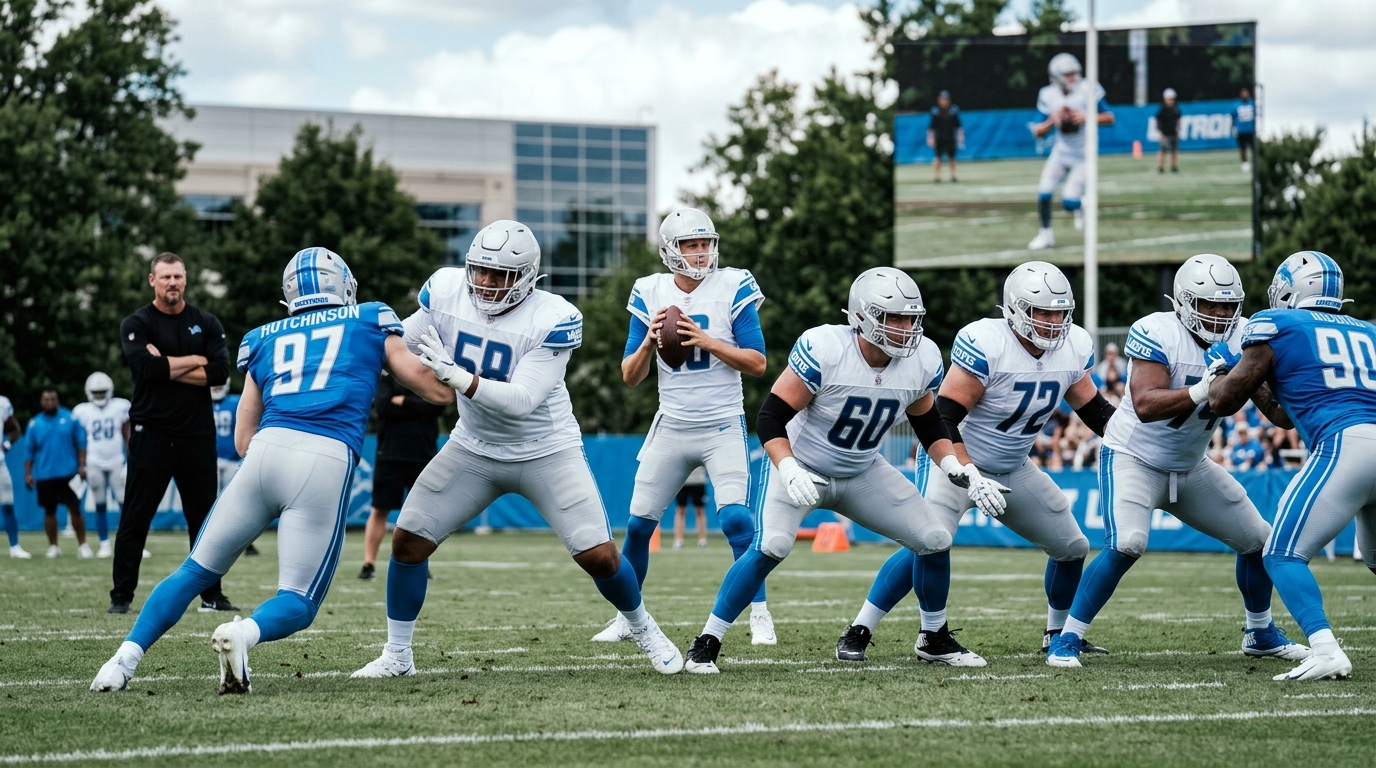
The Lions can have one of the best tackles in the NFL and still have an offensive-line problem if the five-man unit stops functioning together.
That isn’t a criticism of Sewell.
It’s actually proof of how offensive lines work.
Great Offensive Linemen Don’t Play Alone
Football fans naturally evaluate offensive linemen individually.
Did Sewell allow a sack?
Did the guard get pushed backward?
Did the center miss the block?
Those are useful questions.
They’re also incomplete.
Offensive lines function through relationships.
A tackle and guard have to understand how they’re handling games and stunts.
A center has to communicate the defensive front.
Guards have to know when they’re working combination blocks and when they’re climbing to the second level.
Everybody needs to understand protection.
One misunderstanding can ruin four correct decisions.
That’s why offensive-line chemistry gets discussed so often.
Not because coaches like clichés.
Because the unit is interconnected in a way most other position groups aren’t.
Sewell can win outside while the pocket collapses inside.
That’s not hypothetical.
That’s the core problem Detroit has to solve.
The Better Sewell Gets, the Easier It Is to Assume Everything Is Fine
There’s a strange side effect to having an elite player.
He can disguise concern.
Sewell has been so consistently dominant that it’s easy to think of Detroit’s offensive line as one stable object.
Sewell is there.
Therefore, the line should be good.
That’s not how this works.
An offensive line isn’t a five-player All-Star team.
It’s a five-man operating system.
And if the communication breaks down in the middle, the best right tackle in football can’t fix it from the edge.
That’s what makes center such an important position in this conversation.
Detroit isn’t simply replacing Cade Mays’ blocking.
It’s replacing his communication.
His timing with Jared Goff.
His interaction with both guards.
His role in identifying fronts.
His place in an offensive line that was already undergoing transition.
Sewell doesn’t solve those things.
He can stabilize one part of the structure.
He can’t become the entire structure.
Cade Mays’ Injury Changed the Equation
Before the injury, Detroit was still evaluating what this version of the offensive line could become.
That mattered.
Mays wasn’t a finished product.
He was still developing into the center Detroit hoped could help carry the line into the regular season.
Now those reps are being redistributed.
Seth McLaughlin gets more first-team work.
Juice Scruggs remains part of the competition when healthy.
Other combinations become more relevant.
Every one of those changes affects the players around them.
That includes Sewell.
Not because his job suddenly becomes different.
Because the consistency around him becomes less certain.
The offensive line’s ceiling may still begin with Sewell.
Its floor will be determined by everyone else.
Why Center Can Change a Tackle’s World
At first, that sounds strange.
How can a center injury affect a right tackle?
Start with protection.
If the center identifies the front incorrectly, the entire line can adjust incorrectly.
If communication becomes slow, the quarterback has less time to react.
If interior pressure reaches Jared Goff quickly, the edge protection almost stops mattering.
A tackle can execute his block perfectly and still watch the quarterback get hit before the route develops.
That’s why the line is judged by the result rather than the individual grade.
The same thing happens in the running game.
Sewell can generate movement on the edge.
But if the interior loses leverage immediately, the running lane may disappear before Jahmyr Gibbs ever reaches it.
Again, Sewell did his job.
The play still failed.
That’s the burden great players carry inside interconnected systems.
Sometimes individual excellence isn’t enough.
Jared Goff Is Where the Problem Becomes Obvious
If you want to understand the health of Detroit’s offensive line, watch Jared Goff.
He is the clearest indicator.
Goff is at his best when the structure around him is clean.
He doesn’t need every snap to be perfect.
He needs the offense to be predictable in the right ways.
Consistent snaps.
Clear communication.
Enough time to process.
A pocket he understands.
When those things exist, Goff can control a game.
When the middle of the line becomes unstable, everything accelerates.
Pressure arrives faster.
Reads shorten.
Timing changes.
The entire offense begins reacting instead of dictating.
Sewell can erase the best edge rusher on the field.
If Goff can’t step into the pocket because interior pressure arrives immediately, that edge win doesn’t matter nearly as much.
That’s why Detroit’s center competition deserves so much attention.
It’s not about whether the replacement looks good individually.
It’s about whether Goff still looks like Goff.
Jahmyr Gibbs Depends on the Same Structure
The running game tells the same story.
Gibbs is explosive enough to make defenders miss.
He can turn small openings into major gains.
But even elite running backs need information.
Where is the blocking developing?
Which gap is opening?
When should the cut happen?
What is the second-level defender doing?
Interior offensive-line play affects all of those decisions.
If the center and guards are communicating well, Gibbs can press the line, trust the design and accelerate into space.
If that communication breaks down, hesitation creeps in.
And hesitation kills explosive runs.
That’s another reason Sewell’s greatness can’t carry the entire group.
Detroit wants to use Gibbs creatively.
Motion.
Receiving.
Different alignments.
But creativity works best when the foundation underneath it remains stable.
The line is that foundation.
Blake Miller Makes the Future More Interesting
This is where Blake Miller enters the conversation.
Detroit’s first-round rookie represents something important.
Not an immediate solution at center.
A potential long-term answer to how the line remains strong around Sewell.
If Miller develops into another dependable tackle, Detroit gains flexibility.
Maybe Sewell can remain locked into the role where he dominates.
Maybe the line becomes easier to structure around two reliable edges.
Maybe the interior becomes the only part Detroit has to solve.
That’s the long-term benefit of stacking talent on the offensive line.
One elite player raises the ceiling.
Multiple dependable players stabilize the structure.
Holmes understands that.
That’s why Miller’s development matters even while Detroit is dealing with a center problem.
Sewell’s Ranking Is a Compliment — and a Warning
Being recognized among the NFL’s best players is an achievement.
Sewell deserves it.
But the ranking also highlights something useful.
Detroit cannot afford to confuse having one elite lineman with having an automatically elite offensive line.
Those are not the same thing.
The Lions still need:
communication,
depth,
interior stability,
development,
and consistency across all five positions.
That’s the challenge.
Sewell gives Detroit a massive advantage.
But advantages have to be supported.
Otherwise, they become isolated excellence inside an unstable system.
And that’s not enough for a team with championship expectations.
The Real Question Is Whether Detroit Can Protect the Structure
This is where the conversation has to move beyond Penei Sewell.
Because Sewell is already the answer.
Detroit knows what it has in him.
The uncertainty lives around him.
Can the interior line communicate cleanly?
Can the center competition settle quickly enough?
Can younger linemen grow into dependable roles?
Can Detroit survive injuries without shuffling the entire unit?
Those questions matter because offensive-line play is less forgiving than almost any other part of football.
A receiver can have one bad rep and still make the next catch.
A defensive back can get beaten and recover later.
One missed assignment on the offensive line can get your quarterback hit immediately.
That’s why structure matters so much.
This Is Where Depth Stops Being Theoretical
Every team says it values offensive-line depth.
Few know whether they actually have it until something breaks.
Detroit is getting that answer now.
Cade Mays’ injury accelerated the evaluation.
Seth McLaughlin gets a chance to prove he can handle the middle.
Juice Scruggs remains part of the picture when healthy.
Blake Miller becomes more interesting because his development affects how many configurations Detroit can survive.
And every rep carries more weight because the line isn’t evaluating depth in a vacuum anymore.
It’s evaluating whether that depth can preserve the identity of the entire offense.
That’s a much harder test.
Brad Holmes Has To Keep Winning In The Trenches
One of the biggest reasons Detroit became a contender is because Brad Holmes treated the offensive line like infrastructure instead of decoration.
That matters.
Skill players can change games.
Offensive lines determine how often those players get the chance.
Holmes has consistently invested in the trenches because he understands that sustainable offense starts there.
Now the challenge becomes maintaining that strength as the roster gets more expensive.
You can’t solve every injury with another veteran contract.
You can’t keep every experienced lineman forever.
Eventually, younger players have to become trustworthy.
That’s the next phase.
Draft well.
Develop well.
Then trust the development when adversity arrives.
Sewell represents the best-case version of that philosophy.
The rest of the line has to keep proving the pipeline works.
Elite Tackles Create Margin — They Don’t Eliminate Risk
Sewell gives Detroit breathing room.
That matters.
If one edge is consistently secure, the coaching staff can focus protection resources elsewhere.
If the run game can reliably attack his side, Detroit has an identity to lean on when things get messy.
If the line needs help inside, having an elite tackle reduces the number of places coaches need to worry about.
That’s real value.
But it’s margin.
Not immunity.
The interior still has to hold.
The center still has to communicate.
The guards still have to work together.
The snap still has to be clean.
Sewell makes the puzzle easier.
He doesn’t solve it by himself.
Jared Goff Gives Us The Best Test
The easiest way to know whether Detroit’s offensive line is functioning is still the quarterback.
Watch Goff.
Does he look comfortable?
Does he step up naturally in the pocket?
Does he have time to get through progressions?
Are the protections clean enough that the offense can stay aggressive?
If those answers remain yes, Detroit is surviving the transition.
If the offense starts shrinking?
That’s when the warning signs matter.
Quick throws become more frequent.
Deep concepts disappear.
Goff starts reacting to interior pressure.
The entire offense becomes more cautious.
That’s the real consequence of offensive-line instability.
Not one sack.
A smaller offense.
And Detroit cannot afford that if it wants to maximize everything around Goff.
Gibbs’ Versatility Only Works If The Foundation Holds
The same applies to Jahmyr Gibbs.
We’ve talked about using him as more than a traditional running back.
Moving him around.
Creating mismatches.
Using motion to reveal coverage.
All of that sounds great.
But offensive creativity only works when the line gives the play time to develop.
If Detroit has to simplify protections because of uncertainty at center, some of that creativity gets harder to use.
If interior pressure arrives too quickly, Gibbs’ route tree shrinks.
If run-game timing breaks down, the most explosive back on the field starts seeing fewer clean opportunities.
That’s why the offensive line matters even more when you have dynamic skill players.
The better your weapons become, the more important it becomes to protect the conditions that allow them to operate.
Blake Miller Represents The Next Layer
This is where Miller’s development becomes more than a rookie storyline.
He represents continuity.
Not today’s continuity.
Tomorrow’s.
If Miller grows into a dependable starting tackle, Detroit can plan the line around another young cornerstone.
That reduces future uncertainty.
It gives Holmes flexibility when contracts change.
It allows Detroit to protect depth instead of constantly replacing it.
That’s how strong organizations stay strong.
One star becomes two.
Two reliable pieces make the other decisions easier.
And suddenly the offensive line stops depending on one elite player carrying everyone else.
That’s the long-term goal.
The Penei Sewell Ranking Should Change The Question
Instead of asking:
How good is Penei Sewell?
We already know.
The better question is:
How effectively can Detroit build around a player that good?
That’s the real challenge.
Because once you have an elite tackle, wasting that advantage becomes unacceptable.
You need the center communication.
You need guard development.
You need depth.
You need continuity.
You need enough stability that Sewell’s dominance becomes part of a complete unit rather than an isolated bright spot.
That’s what championship offensive lines do.
They don’t simply have one great player.
They remove obvious weaknesses.
Final Thoughts
Penei Sewell’s NFL ranking is deserved.
It confirms what Lions fans already understand.
He is one of the best offensive linemen in football.
But that recognition also creates a useful reminder.
Detroit’s offensive-line strength cannot begin and end with Sewell.
Cade Mays’ injury exposed that reality.
The line was already changing.
The center position was still being evaluated.
Younger players were still developing.
Now Detroit has to accelerate that process without allowing the rest of the offense to lose its identity.
That’s the test.
Sewell can dominate the edge.
But Detroit still needs the middle.
Jared Goff still needs structure.
Jahmyr Gibbs still needs clean timing.
The offense still needs five players operating like one.
That’s why this ranking should be celebrated.
And understood correctly.
Penei Sewell raises the ceiling of the Lions’ offensive line.
He doesn’t guarantee the floor.
The floor will be determined by how well Detroit develops the players beside him, how quickly the center situation stabilizes, and whether Brad Holmes’ offensive-line depth is strong enough to survive the kind of adversity every championship season eventually brings.
That’s the uncomfortable truth.
The Lions may have one of the best tackles in football.
Now they have to prove they still have one of the best offensive lines.
Those are not automatically the same thing.
What Do You Think?
Does Penei Sewell’s presence make you confident Detroit’s offensive line will stabilize, or are you more concerned about the interior after Cade Mays’ injury?
And which young lineman do you think matters most to the long-term future of the group: Seth McLaughlin, Blake Miller, Juice Scruggs, or someone else?
Share your thoughts in the comments below.