The Lions Just Revealed What Their Championship Plan Looks Like
The Lions Just Revealed What Their Championship Plan Looks Like
There comes a moment in every successful rebuild when the questions surrounding a football team begin to change.
For years, the Detroit Lions were evaluated by what they needed.
They needed more talent.
They needed more depth.
They needed better draft classes.
They needed to prove they could compete with the NFL’s elite.
Those questions fueled every offseason conversation because the Lions were still trying to become contenders.
That isn’t the conversation anymore.
If Day 9 of training camp revealed anything, it’s that the Lions have officially entered a new phase of their evolution.
They’re no longer building a championship-caliber roster.
They’re managing one.
At first glance, the headlines from practice seemed unrelated.
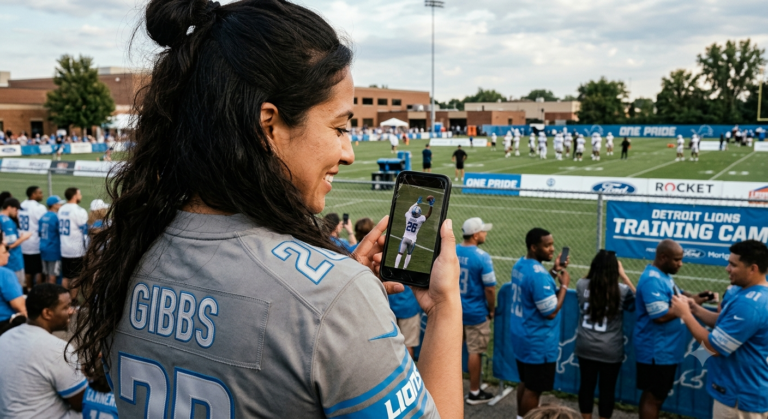
Jahmyr Gibbs returned to full participation and immediately handled a significant workload.
Several veteran starters received scheduled rest.
Dan Campbell offered insight into how he’ll approach the preseason.
The Lions continued to monitor D.J. Reed’s recovery without expressing significant concern.
Meanwhile, reports highlighted that Detroit has now committed more than $1 billion in extensions to the core players Brad Holmes believes can sustain championship contention.
Look at those stories together instead of individually, and a clear pattern begins to emerge.
Every decision points toward one organizational priority: protect the championship window Brad Holmes and Dan Campbell spent years building.
Protect what you’ve built.
A Different Kind of Training Camp
Training camp looks very different depending on where a franchise sits in its competitive cycle.
Teams coming off losing seasons often approach August with urgency.
Every veteran plays.
Every preseason snap feels important.
Coaches are searching for answers.
The Lions aren’t searching anymore.
That transition has been years in the making, and the Lions have finally reached the moment Brad Holmes has been preparing for.
They’re refining.
That’s a significant difference.
When Detroit holds established starters out of certain practice periods, it isn’t because the coaching staff has questions about those players.
It’s because it already has answers.
Campbell and Brad Holmes know exactly what players like Penei Sewell, Aidan Hutchinson, Amon-Ra St. Brown, Brian Branch, and Jahmyr Gibbs bring to the football team.
Those players don’t need to prove they belong.
The organization needs them healthy when the games begin to matter.
That’s the mindset of a team preparing for January, not trying to win headlines in August.
The Billion-Dollar Commitment Tells the Story
One of the most revealing developments of camp didn’t happen on the practice field.
It happened on the balance sheet.
Reports that Detroit has now committed more than $1 billion toward retaining its core players aren’t simply a financial milestone.
They’re a statement of belief.
Brad Holmes has spent years identifying players who fit the culture Dan Campbell wanted to create.
Physical.
Competitive.
Selfless.
Accountable.
When Holmes commits resources on that scale, he isn’t simply rewarding past performance.
He’s investing in future continuity.
That approach reflects Detroit’s larger willingness to choose organizational trust over constantly chasing outside star power.
The Lions believe their championship window isn’t opening.
They believe it’s already open.
Every extension is designed to keep that window open for as long as possible.
That’s a fundamentally different philosophy than constantly rebuilding through free agency every offseason.
Jahmyr Gibbs’ Return Was About More Than Participation
No player attracted more attention on Day 9 than Jahmyr Gibbs.
Understandably so.
After days of discussion surrounding his contract situation and temporary hold-in, his return to full participation immediately became one of the biggest stories in Allen Park.
But the most interesting detail wasn’t that he practiced.
It was how he practiced.
Reports consistently described an increase in his workload.
Detroit didn’t appear interested in cautiously hiding one of its most dynamic offensive weapons.
Instead, the coaching staff integrated him back into the offense in ways that reminded everyone exactly why the organization has invested so heavily in him.
That’s an important distinction.
The Lions aren’t managing Gibbs like a player whose importance is uncertain.
They’re managing him like one of the foundational pieces of the offense.
Campbell has already described Gibbs in terms that explain why Detroit views him as far more than a traditional running back.
Those are two very different approaches.
Veteran Rest Isn’t a Warning Sign
Every August, veteran rest sparks concern among fans.
Why isn’t a starter practicing?
Is someone injured?
Should we be worried?
Sometimes those questions are justified.
Most of the time, especially for contenders, they’re not.
One of the benefits of building a deep roster is the freedom to think beyond today’s practice.
Campbell understands that a healthy veteran in January provides far more value than an exhausted veteran in early August.
That’s why rest days should be viewed differently than they were only a few years ago.
When Detroit selectively limits the workload of established starters, it’s acknowledging something successful franchises eventually learn.
Preparation isn’t about doing the most.
It’s about doing what’s necessary.
The coaching staff has reached the point where preserving health is just as important as evaluating talent.
Young Players Are Competing for Different Jobs Now
That shift affects the rest of the roster too.
Earlier in the rebuild, young players were competing to become starters because the roster desperately needed impact talent.
Today’s competitions feel different.
Most young players are no longer trying to replace established stars.
They’re trying to prove they can complement them.
Reserve linebackers.
Rotational defensive linemen.
Backup offensive linemen.
Depth receivers.
Developmental defensive backs.
Those players aren’t carrying the pressure of rescuing the franchise.
They’re competing to strengthen one that already believes it can compete for a championship.
That’s a much healthier environment for player development.
It also reflects how dramatically the Lions’ roster has changed under Brad Holmes.
The challenge is no longer finding enough NFL-caliber players.
It’s deciding which good football players deserve supporting roles behind an exceptionally strong core.
Dan Campbell Is Coaching for September, Not August
One of the easiest traps during training camp is confusing activity with progress.
More snaps don’t automatically make a team better.
More preseason reps don’t automatically make veterans more prepared.
More contact doesn’t automatically create more toughness.
Sometimes the smartest thing a coach can do is know when his players have already shown him enough.
That’s the balancing act Dan Campbell faces now.
When asked about Jared Goff’s potential involvement in the preseason opener, Campbell’s answer became part of a much larger conversation about how Detroit intends to handle its established players.
The question isn’t whether Goff could benefit from preseason work.
Every player can.
The real question is whether those snaps provide enough value to justify the risk.
For a franchise with legitimate championship expectations, that calculation changes.
Detroit isn’t entering the preseason searching for an offensive identity.
It already has one.
Goff doesn’t need August to prove he can command this offense.
The Lions need him healthy when the games begin counting.
That’s the natural progression from the earlier stage of camp, when putting on the pads shifted Detroit from installation toward real evaluation.
And that same logic extends across much of the roster.
The Opportunity Doesn’t Disappear — It Moves Down the Depth Chart
Protecting established starters doesn’t mean preseason football becomes meaningless.
Quite the opposite.
The opportunity simply shifts.
Every snap Goff doesn’t take becomes an opportunity for another quarterback.
Every rep an established defensive starter sits out creates a chance for someone fighting for the 53-man roster.
Every veteran rest day gives coaches more film on the players they still need answers about.
That’s where this stage of training camp becomes especially important.
Luke Altmyer, for example, has an entirely different relationship with the preseason than Goff.
For Goff, preseason snaps are optional preparation.
For Altmyer, they’re an audition.
The same applies throughout the roster.
The stars are preparing for September.
The reserves are trying to earn September.
Detroit’s increased emphasis on situational football is already revealing which reserves the coaching staff can trust when those opportunities arrive.
That’s one of the clearest signs of how dramatically Detroit’s roster has evolved.
Depth Is No Longer a Luxury
Championship teams rarely survive an entire season with their preferred starting lineup intact.
Someone gets hurt.
Someone misses a game.
A starter needs a reduced workload.
A young player gets thrown into a situation nobody expected in August.
That’s why the bottom third of the roster matters so much.
Brad Holmes understands this better than most.
Detroit’s recent roster construction suggests the organization isn’t simply asking:
Who are our best 22 players?
It’s asking:
How many different ways can this roster survive adversity?
That’s a much more important question over a 17-game season.
The Devin White signing offered another example of Brad Holmes building depth before a potential weakness could become a crisis.
Detroit didn’t wait for a potential weakness to become a crisis.
It added experience immediately.
That’s what roster management looks like when expectations change.
Contenders don’t simply build starting lineups.
They build contingency plans.
The Backup Quarterback Situation Proves the Point
Teddy Bridgewater’s decision to step away from the Lions created another test of that philosophy.
Backup quarterback isn’t the position fans want to think about.
If everything goes according to plan, the backup barely sees the field.
But championship planning can’t assume everything will go according to plan.
That’s the entire point.
Jared Goff is the engine of Detroit’s offense.
Protecting the season means having a credible plan behind him.
That’s why Detroit’s reported move to bring in Josh Dobbs makes sense within the larger strategy.
The Lions aren’t looking for someone to replace Goff.
They’re looking for someone capable of keeping the season alive if circumstances force Detroit to play without him.
That’s a very different job description.
And it’s another reminder that Holmes is constructing the roster around scenarios he hopes never happen.
Good teams prepare for their best-case scenario.
Championship organizations prepare for the worst one too.
Jahmyr Gibbs Changes the Equation
Then there’s Gibbs.
His return to full participation provided a reminder of what Detroit’s offense can become when its most dynamic players are available.
Gibbs isn’t simply another piece of the system.
He changes the geometry of the field.
Linebackers have to respect his speed.
Safeties have to account for him in space.
Defenses can’t assume his alignment tells them where the football is going.
That’s why his increased usage after returning to practice matters.
The Lions aren’t trying to figure out whether Gibbs belongs at the center of the offense.
They’re experimenting with how many different ways they can make defenses deal with him.
That’s the privilege of continuity.
Instead of spending August teaching the offense what it wants to become, Detroit can spend August expanding what it already does well.
That difference matters.
More Than $1 Billion Is Really a Bet on Continuity
The headline number is enormous.
More than $1 billion committed to core players.
But focusing only on the money misses the larger point.
Detroit is buying continuity.
The way Detroit handled Jahmyr Gibbs’ contract situation showed the same preference for stability over public panic.
That’s what the investment represents.
Continuity between quarterback and offensive line.
Continuity between stars and coaching staff.
Continuity between the players who helped establish the culture and the younger players now entering it.
The NFL makes sustained success incredibly difficult.
Salary caps force choices.
Free agency removes depth.
Coaching staffs get poached.
Draft position gets worse as teams improve.
Everything about the league is designed to pull successful rosters apart.
Holmes’ challenge is figuring out how to resist that gravity for as long as possible.
Keeping the right core together gives Detroit a chance.
But it also raises the stakes.
Once you’ve committed this heavily to a group of players, development can’t stop.
Drafting can’t become less efficient.
Depth can’t become an afterthought.
The Lions now have to build around expensive stars without losing the characteristics that made the roster successful in the first place.
That’s the next challenge of the rebuild.
And in some ways, it may be harder than the first.
The Lions Have Graduated to a Different Problem
That’s what makes this training camp so fascinating.
Detroit’s biggest questions are no longer the questions of a rebuilding franchise.
Can we find a quarterback?
Can we build an offensive line?
Can we identify cornerstone players?
Can we establish a culture?
Holmes and Campbell have already answered those questions.
Now the questions are harder.
Can they keep the roster healthy?
Can they maintain enough depth behind expensive stars?
Can young players develop quickly enough to replace veterans who eventually leave?
Can the organization survive injuries without lowering its expectations?
Can Detroit remain hungry after becoming one of the teams everyone else wants to beat?
Those are championship problems.
And that’s exactly what the Lions wanted.
Final Thoughts
Day 9 of Detroit Lions training camp could easily be reduced to a collection of unrelated updates.
Jahmyr Gibbs returned.
Veterans rested.
D.J. Reed continued working through a manageable injury situation.
Young players received additional opportunities.
Questions emerged about Jared Goff’s preseason workload.
The backup quarterback situation changed.
But step back far enough and those stories begin telling the same story.
The Lions are protecting something now.
Not protecting it out of fear.
Protecting it because they understand its value.
Brad Holmes spent years assembling the core.
Dan Campbell spent years establishing the culture.
The players spent years transforming expectations around this franchise.
Now comes the next stage.
Maintaining it.
That’s why veteran rest matters.
That’s why depth matters.
That’s why backup quarterback matters.
That’s why keeping cornerstone players together matters.
And that’s why the billion-dollar commitment shouldn’t simply be viewed as a collection of enormous contracts.
It’s Detroit placing a bet on itself.
The organization believes this core can win.
Not someday.
Now.
The question facing the Lions is no longer whether they’ve built a championship-caliber team.
It’s whether they can protect it, develop around it, and keep it together long enough to finish the job.
Training camp is giving us the first glimpse of how they intend to try.
And the plan looks increasingly clear:
Protect the stars.
Develop the depth.
Prepare for adversity.
Keep the core together.
And make sure the football team Detroit wants in January is healthier, deeper, and more prepared than the one we’re watching in August.
That’s not rebuilding anymore.
That’s championship management.
What Do You Think?
Has Detroit reached the point where the Lions should prioritize protecting their established stars throughout the preseason, or do you still want to see players like Jared Goff and Jahmyr Gibbs get meaningful game reps before Week 1?
And when you look at the roster Brad Holmes has built, which position concerns you most if injuries test Detroit’s depth during the season?
Share your thoughts in the comments below.
What is the Detroit Lions’ championship window?
Detroit’s championship window refers to the period in which its current core of established players, coaching continuity and roster depth gives the team a realistic opportunity to compete for a Super Bowl.
Why are the Lions resting veterans during training camp?
Established veterans don’t need the same volume of evaluation as younger players. Managing their workloads allows Detroit to reduce unnecessary wear while creating additional evaluation opportunities for reserves.
Why is Jahmyr Gibbs so important to the Lions’ offense?
Gibbs affects Detroit beyond traditional rushing production because his speed and receiving ability create matchup problems and allow the offense to use him from multiple alignments.
Why does roster depth matter for a championship contender?
NFL teams rarely remain completely healthy throughout a season. Quality depth allows a contender to absorb injuries without dramatically changing its identity or expectations.