The Lions Defense Is Starting to Create the Kind of Chaos Detroit Has Been Missing
The Lions Defense Is Starting to Create the Kind of Chaos Detroit Has Been Missing
There are good defensive practices.
And then there are practices where the offense starts feeling uncomfortable before the snap.
That’s a different thing entirely.
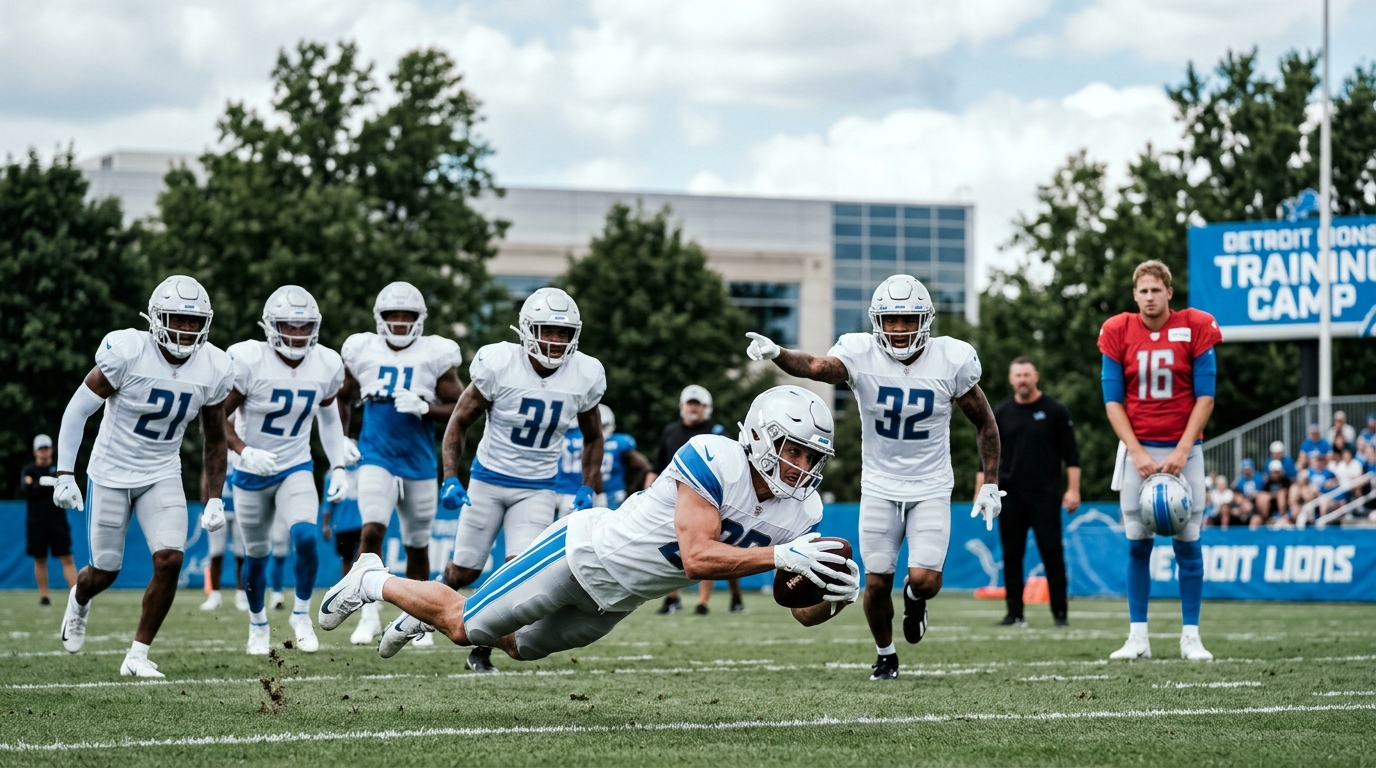
Day 10 of Detroit Lions training camp offered a glimpse of that second version.
The secondary created turnovers.
Multiple defenders got their hands on the football.
The defense forced Jared Goff and the offense to reset, adjust and respond.
And even though the offense eventually answered during situational work, the more interesting story wasn’t who “won” practice.
It was the kind of pressure Detroit’s defense created along the way.
Because the Lions don’t simply need a defense that allows fewer yards.
They need a defense that changes possessions.
That’s what separates a competent unit from a dangerous one.
And if the first few weeks of camp are revealing anything, Detroit’s defense may finally be developing the kind of chaos that can change football games.
Four Interceptions Matter — But Not for the Reason You Think
Training camp interceptions are easy to overreact to.
Quarterbacks experiment.
Receivers run new concepts.
Defensive backs sometimes know what’s coming because they’ve seen the same offense for weeks.
Nobody should look at four interceptions in one practice and assume Detroit suddenly has the NFL’s best secondary.
That’s not what matters.
What matters is how those interceptions happened.
Was the quarterback forced to hold the football?
Did coverage disguise create hesitation?
Did defenders communicate well enough to pass routes off?
Did pressure alter the timing of the throw?
Did a safety recognize something before the offense could exploit it?
Those are the questions worth asking.
Turnovers are rarely isolated events.
They are often the final result of several defenders doing their jobs correctly before the ball arrives.
That’s why a practice filled with interceptions can tell us more about defensive development than the box-score number alone.
The Lions Need More Than a Defense That Survives
For much of Detroit’s rise, the offense has carried the identity of the team.
Jared Goff controls games.
Jahmyr Gibbs creates explosive plays.
Amon-Ra St. Brown keeps drives alive.
The offensive line establishes physicality.
The defense has had strong stretches.
It has produced stars.
But Detroit’s championship ceiling changes if the defense becomes more than a unit trying to keep games manageable.
The Lions need a defense capable of stealing possessions.
One turnover can erase a bad offensive series.
One interception can turn a seven-point deficit into a scoring opportunity.
One forced fumble can change field position instantly.
That’s why takeaways matter so much for contenders.
They create opportunities the offense didn’t earn.
Detroit already has enough offensive talent to take advantage of those opportunities.
The defense simply has to create more of them.
Chaos Starts Before the Football Is Thrown
Fans often focus on the player who catches the interception.
Coaches usually look earlier in the play.
What caused the quarterback to throw it?
Maybe pressure forced him off his first read.
Maybe a safety rotation changed after the snap.
Maybe a linebacker widened underneath a route.
Maybe a corner disguised leverage differently than the quarterback expected.
That is where defensive chaos actually begins.
It’s not random.
It’s coordinated uncertainty.
The best defenses create enough confusion that quarterbacks stop playing on time.
And Jared Goff is an excellent measuring stick for that.
Goff thrives when the picture is clear.
He diagnoses.
He gets the ball out.
He punishes mistakes.
If Detroit’s defense can consistently force him to hesitate during practice, that’s useful information.
Not because beating Goff in August proves anything about January.
Because making an experienced quarterback uncomfortable is exactly the kind of stress test this defense needs.
The Secondary Is Starting to Play Faster
One of the most encouraging things about Detroit’s secondary is that the group increasingly looks less reactive.
That’s important.
Defensive backs who are thinking too much play slowly.
They’re a half-step late.
They hesitate before driving on the football.
They wait for the route to reveal itself instead of recognizing the concept early.
Confidence changes that.
Communication changes that.
Repetition changes that.
When defensive backs trust the call and trust the players beside them, they start playing forward instead of backward.
That’s when interceptions begin appearing.
Not because every defender suddenly has elite ball skills.
Because recognition happens sooner.
That extra half-second matters.
It can turn a completion into a breakup.
A breakup into a tipped ball.
A tipped ball into a turnover.
Those margins are tiny.
Championship defenses live inside them.
Brian Branch Changes the Personality of the Entire Unit
Every defense needs players who create urgency.
Brian Branch has become one of those players for Detroit.
His value isn’t confined to one alignment.
He can attack downhill.
Cover.
Pressure.
Disguise.
Play with physicality.
Most importantly, he plays like something is supposed to happen on every snap.
That mentality spreads.
When one player consistently attacks the football, teammates begin anticipating opportunities instead of merely reacting.
That’s one reason Branch matters so much to the identity of this defense.
Detroit doesn’t need eleven players trying to imitate him.
It needs eleven players operating with the same urgency.
Find the football.
Attack the football.
Finish the play.
That’s how turnovers become part of a defensive personality instead of random events.
Pressure and Coverage Have to Work Together
One of the easiest mistakes when evaluating defenses is separating the pass rush from the secondary.
They are deeply connected.
A cornerback can cover perfectly for three seconds and still lose if the quarterback has six.
A defensive lineman can create pressure and still watch the quarterback escape if the coverage breaks immediately.
The strongest defenses make those pieces work together.
Pressure speeds up the quarterback.
Coverage removes easy answers.
The quarterback holds the ball another fraction of a second.
The rush gets closer.
Now the entire play becomes uncomfortable.
That’s the cycle Detroit needs.
And that’s why turnover-heavy practice days can become encouraging even when the offense eventually responds.
The goal isn’t for the defense to dominate every rep.
The goal is to make the offense earn clarity.
Situational Football Makes These Turnovers More Interesting
This stage of camp matters too.
Detroit isn’t simply running isolated install periods anymore.
The team is spending more time in situational work.
Third downs.
Two-minute offense.
End-of-game scenarios.
Pressure situations.
That changes the value of a defensive takeaway.
An interception on first-and-10 during an early install period is one thing.
Creating a turnover when the offense understands the clock, down and distance, and objective is something else.
That’s where trust begins to matter.
Can the defense maintain communication when the offense speeds up?
Can players disguise without creating confusion among themselves?
Can the secondary stay disciplined when Goff knows exactly what he needs?
Those are regular-season questions.
Camp is finally starting to provide answers.
The Offense Answering Back Is Actually Good News
There’s another part of Day 10 worth appreciating.
The offense eventually responded.
Some fans might see that as the defense losing momentum.
I see it differently.
That’s exactly what good training camp should look like.
Defense creates problems.
Offense adjusts.
Offense finds answers.
Defense gets better information.
Nobody benefits from one side dominating practice every afternoon.
If Detroit’s defense intercepts everything, maybe the offense isn’t challenging it enough.
If the offense scores at will, maybe the defense isn’t creating enough discomfort.
The back-and-forth matters.
Championship teams sharpen themselves.
That’s what situational football is supposed to reveal.
Turnovers Could Become the Shortcut Detroit’s Offense Doesn’t Need — But Will Gladly Take
Here’s where the larger team picture becomes interesting.
Detroit’s offense is already built to sustain drives.
It doesn’t need constant short fields to survive.
That’s exactly why defensive takeaways become so valuable.
A weaker offense depends on turnovers.
A strong offense weaponizes them.
Give Goff the football near midfield after an interception.
Give Gibbs a short field.
Give Detroit’s offensive line a defense that just played a stressful series and now has to come right back onto the field.
That’s how games tilt.
One takeaway becomes seven points.
Seven points changes the opposing offense’s play-calling.
Now the pass rush gets better opportunities.
Now another turnover becomes possible.
That’s how good teams create separation.
The defense doesn’t need to carry Detroit.
It needs to create moments that let the rest of the roster become more dangerous.
Detroit Doesn’t Need the No. 1 Defense
This may be the most important point.
Fans love rankings.
Top five.
Top ten.
Number one in yards.
Number one in scoring.
Those are useful measurements.
But Detroit doesn’t need to finish first in every defensive category to win a championship.
It needs a defense that complements the rest of the roster.
Get off the field on third down.
Create turnovers.
Prevent explosive plays.
Win enough red-zone snaps.
Give Goff extra possessions.
Force opponents to play from uncomfortable situations.
That’s the formula.
A defense that does those things can become championship-caliber without dominating every statistical category.
That’s why this version of Detroit’s defense may ultimately be more important than one that simply allows fewer yards.
The Lions need impact.
Turnovers Reveal Confidence
There’s also something psychological happening when a defense starts creating takeaways.
Players become aggressive.
Not reckless.
Aggressive.
Corners drive on routes.
Safeties trust their reads.
Linebackers attack passing lanes.
Pass rushers pursue the quarterback expecting something good to happen behind them.
That confidence changes how a defense plays.
And confidence matters because hesitation is expensive in the NFL.
A defender who knows where he’s going plays faster.
A defense that knows what it’s trying to create becomes more dangerous.
The next step is making sure aggression doesn’t become undisciplined.
That’s where Dan Campbell and the coaching staff matter.
Create chaos without creating mistakes.
Attack without losing leverage.
Disguise without confusing yourself.
That’s the balance.
Final Thoughts
Four interceptions in training camp aren’t a championship prediction.
They shouldn’t be treated like one.
But they can become evidence.
Evidence that defenders are communicating.
Evidence that coverage recognition is improving.
Evidence that Detroit’s secondary is playing with more confidence.
Evidence that pressure and coverage are beginning to work together.
Evidence that the defense is trying to do more than survive possessions.
That’s what makes Day 10 interesting.
The Lions have spent years building an offense capable of controlling football games.
Maybe the next evolution is building a defense capable of interrupting them.
A turnover interrupts rhythm.
Pressure interrupts timing.
Disguise interrupts confidence.
Physicality interrupts comfort.
Put those things together, and a defense begins doing something far more valuable than simply preventing yards.
It begins creating chaos.
And chaos may be exactly what Detroit has been missing.
The Lions don’t need their defense to become the star of the team.
They need it to make enough winning plays that the stars already on the roster become even harder to beat.
Give Jared Goff extra possessions.
Give Jahmyr Gibbs short fields.
Force opponents to chase points.
Make quarterbacks hesitate.
Change games one possession at a time.
That’s the version of Detroit’s defense worth watching as training camp continues.
Not because it picked off four passes in one August practice.
Because the process behind those turnovers may be showing us what this defense wants to become.
What Do You Think?
What would represent a successful season for Detroit’s defense to you?
Does it need to become a top-five statistical unit, or would you rather see more turnovers, better third-down defense and more game-changing possessions?
And which Lions defender do you believe could create the most chaos this season?
Share your thoughts in the comments below.
Chaos Only Matters If It Travels
Training camp can create false confidence.
A defense gets hot for a day.
The secondary grabs interceptions.
The pass rush wins a few periods.
Everybody leaves practice talking about momentum.
Then September arrives and none of it matters.
That’s the standard Detroit has to avoid.
The question isn’t whether the Lions can create chaos against their own offense in August.
It’s whether they can carry that identity into games where the opponent hasn’t spent two weeks practicing against the same concepts.
That’s the next step.
Turnovers have to become repeatable.
Pressure has to become dependable.
Communication has to survive unfamiliar formations.
The defense has to create discomfort against opponents that don’t know what’s coming.
That’s when camp development becomes regular-season value.
Third Down Is Where This Identity Has to Show Up
If Detroit truly wants a more disruptive defense, third down may become the best place to measure it.
That’s where offenses reveal their intentions.
That’s where quarterbacks know they have to convert.
That’s where coverage and pressure can work together most aggressively.
A defense that consistently forces third-and-long already creates advantage.
A defense that can turn those situations into sacks, rushed throws, tipped passes and interceptions creates something even more valuable.
Possession swings.
That’s the difference.
Stopping a drive is good.
Stealing a possession is better.
And if Detroit’s defense can begin producing more of those moments, the entire game changes.
Brian Branch Can Be the Trigger
Every aggressive defense needs somebody who seems to speed everybody else up.
Brian Branch can be that player.
He’s physical enough to affect the run.
Instinctive enough to attack underneath routes.
Versatile enough to move around.
Aggressive enough to create pressure.
Those qualities matter because offenses hate uncertainty.
Where is Branch lining up?
Is he covering?
Is he blitzing?
Is he rotating late?
Is he triggering downhill?
The more Detroit can force quarterbacks to ask those questions, the more opportunities other defenders have to play fast.
Branch doesn’t need to make every turnover himself.
Sometimes his value comes from creating the confusion that leads to someone else’s play.
That’s how defensive stars elevate an entire unit.
Kerby Joseph Makes the Back End More Dangerous
The same thing applies to Kerby Joseph.
His value isn’t just ball production.
It’s anticipation.
Veteran safeties who recognize concepts quickly make the entire secondary more aggressive.
Corners can trust help.
Linebackers can pass routes off.
The defense can disguise longer.
That’s where communication begins turning into turnovers.
And leadership matters here too.
Detroit doesn’t simply need defenders who know what to do.
It needs defenders who help everyone else know what to do faster.
That may be one of the most important reasons the secondary has a chance to become much more disruptive in 2026.
Derrick Barnes Gives Detroit Another Layer
The linebacker level is part of the same picture.
Derrick Barnes’ development gives Kelvin Sheppard more flexibility.
A linebacker who can handle multiple responsibilities makes disguises harder to read.
If Barnes can defend the run, carry coverage responsibilities and threaten pressure from different alignments, Detroit can create confusion without constantly changing personnel.
That’s valuable.
Offenses want information before the snap.
Versatile defenders remove information.
The less a quarterback knows, the slower the operation becomes.
And a fraction of hesitation is sometimes all a pass rush needs.
The Best Chaos Is Controlled
This is where discipline matters.
There is a bad version of chaos.
Missed assignments.
Overaggressive angles.
Busted coverages.
Defenders jumping routes while giving up explosives behind them.
Detroit can’t confuse aggression with recklessness.
The goal isn’t to create random football.
It’s to create controlled unpredictability.
Disguise the coverage.
Pressure from unexpected places.
Force quarterbacks to process.
Then execute the responsibility.
That’s what separates a dangerous defense from a sloppy one.
And that’s why Campbell’s emphasis on execution still matters here.
Detroit can be aggressive.
It just can’t be careless.
The Offense Should Benefit Immediately
This is where the entire roster begins connecting.
Imagine Detroit’s defense forcing an interception near midfield.
Now Jared Goff gets the ball without needing to drive 80 yards.
Imagine the defense creating a three-and-out after a long offensive possession.
Now Jahmyr Gibbs gets another opportunity against a tired front.
Imagine Brian Branch forcing a fumble inside the opponent’s territory.
Now Detroit can attack before the defense has time to settle.
Those are hidden offensive advantages created by defense.
That’s why takeaways matter so much.
They change field position.
They change tempo.
They change play-calling.
They create psychological pressure.
A strong offense doesn’t need those gifts.
That makes them even more dangerous when they arrive.
Short Fields Can Turn Good Offenses Into Ruthless Ones
Detroit already has the kind of offense that can sustain long drives.
That means a short field becomes a luxury.
And luxury can become punishment.
Defenses facing Detroit already have to deal with Goff’s timing, Gibbs’ versatility, St. Brown’s reliability and the offensive line’s physicality.
Now imagine being asked to defend that group starting at your own 42-yard line because Detroit’s defense just created a turnover.
That’s how games get away from teams.
One possession becomes two.
Two becomes a two-score lead.
A two-score lead changes the opponent’s offense.
Now quarterbacks throw more.
Pass rushers attack more aggressively.
Interceptions become more likely.
That’s how defensive chaos can compound.
Detroit Doesn’t Need to Win Every Defensive Snap
This is another important point.
The Lions don’t need perfection.
They don’t need to shut out good offenses.
They don’t need to dominate every drive.
They need enough winning moments.
Get off the field on third down.
Create a turnover.
Force a red-zone field goal.
Win one fourth-down snap.
Pressure the quarterback on a critical series.
Those moments decide playoff games.
That’s why defensive growth should be measured through impact, not just aggregate statistics.
How many possessions did the defense change?
How many drives did it end?
How many short fields did it create?
How often did it force opponents away from their preferred plan?
Those questions may tell us more than raw yardage totals.
What Real Improvement Would Look Like
So what would make Detroit’s defense meaningfully better in 2026?
Not hype.
Not one practice.
Not four interceptions in August.
Real improvement would look like:
Fewer explosive plays.
More takeaways.
Better third-down results.
More consistent pressure.
Cleaner communication.
Stronger red-zone defense.
Fewer moments where one mistake turns into a touchdown.
That’s the standard.
If Detroit improves in those areas, the defense doesn’t need to become the league’s best.
It simply needs to become a unit opponents respect.
A unit capable of changing games.
A unit that creates opportunities instead of merely limiting damage.
The Ceiling of the Team Changes If the Defense Becomes Opportunistic
This may be the biggest implication of all.
Detroit’s offense already gives the Lions a high floor.
If the defense becomes more opportunistic, the team’s ceiling rises.
That’s because great offensive teams can still lose when every game requires perfection.
One turnover.
One stalled drive.
One missed field goal.
And suddenly the entire outcome changes.
An aggressive defense provides margin.
It gives the offense extra chances.
It reduces the burden on Goff.
It allows Detroit to survive imperfect games.
That’s what championship teams need.
Not flawless football.
Margin for error.
Final Thoughts
Day 10 gave Detroit fans an encouraging picture.
Interceptions.
Aggressive secondary play.
Defenders flying around.
An offense forced to adjust.
But the real value of that practice won’t be known for weeks.
Maybe those turnovers become a pattern.
Maybe they don’t.
Maybe the defense carries this communication and confidence into September.
Maybe unfamiliar opponents expose weaknesses camp couldn’t.
That’s why the next stage matters.
The Lions have to take the chaos they’ve created in practice and turn it into something portable.
Something repeatable.
Something disciplined enough to survive real football.
If they can do that, Detroit’s defense doesn’t need to become the identity of the team.
It simply needs to become the unit that changes the game often enough for the offense to finish it.
That’s a dangerous formula.
Goff doesn’t need another 80-yard drive if the defense gives him the ball at midfield.
Gibbs doesn’t need 25 touches if a turnover creates another scoring opportunity.
St. Brown doesn’t need to rescue every possession if the defense gives Detroit an extra one.
That’s how complementary football is supposed to work.
And that may be the bigger story developing in Allen Park.
For years, Detroit’s offense has been asked to control games.
Now the defense may finally be learning how to interrupt them.
If that evolution is real, then the Lions won’t just be harder to score against.
They’ll be harder to recover against.
And that’s the kind of chaos that can carry all the way into January.
What Do You Think?
What would convince you that Detroit’s defense has truly taken the next step?
Would you rather see more takeaways, better third-down defense, more pressure, or fewer explosive plays?
And which defender do you think is most likely to become the player who changes games for the Lions this season?
Share your thoughts in the comments below.